
Sustainability has moved from a corporate buzzword to a genuine engineering and procurement priority. As industries face mounting pressure to reduce energy consumption, cut waste, and lower carbon emissions, the manufacturing process used to produce metal components has come under closer scrutiny. The cold forging process - which shapes metal at or near room temperature without the need for heating furnaces - offers a compelling sustainability profile that hot forging and casting simply cannot match. From energy savings and material efficiency to a reduced carbon footprint across the production lifecycle, cold forging delivers environmental advantages that align well with the sustainability goals of modern industrial manufacturers. This article examines those benefits in practical terms.
How Does Cold Forging Reduce Energy Consumption?
No Furnace Heating Required at Any Stage
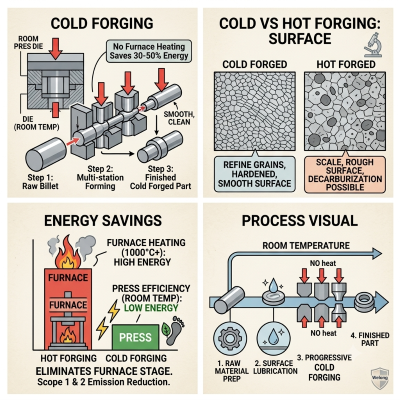
The biggest direct energy benefit of cold forging is that the block doesn't have to be heated at all. Getting metal to temperatures of 1,000°C or higher is needed for hot forging. This process uses a lot of natural gas or power and loses a lot of heat before it even gets to the press. The process of cold forging happens at room temperature, so no furnace energy is used during production. This gap is big for companies that run production lines that make a lot of things. When comparing cold and hot forging processes for the same number of parts, energy audits always show that cold forging uses a lot less energy per kilogram of finished part.
Higher Press Efficiency Per Production Cycle
Because the cold forging process does not require thermal management between operations - no waiting for billets to reach temperature, no heat loss during transfer, no temperature monitoring - press cycles can be run more continuously and efficiently. High-speed cold forging presses can produce parts at rates that hot forging equipment cannot match, meaning more output per unit of electrical energy consumed by the press itself. This cycle efficiency compounds the direct energy savings from eliminating heating, making the cold forging process one of the most energy-lean options available in precision metal component manufacturing.
Material Efficiency in Cold Forging Processes
Near-Net Shape Production Reduces Raw Material Input
The cold forging process is inherently a near-net shape manufacturing method. Metal is displaced within a die rather than removed, meaning the finished component geometry is achieved with very little cold forging process excess material. Compared to machining from a billet - where significant material is cut away as chips - the cold forging process uses a much higher proportion of the input material in the finished part. This improved buy-to-fly ratio is directly tied to sustainability: less raw material needs to be mined, refined, and transported for each part produced, reducing the environmental burden at every upstream stage of the supply chain.
Tight Tolerances That Minimise Secondary Operations
When cold forging, one benefit of the material that is often ignored is its ability to make parts with tight tolerances on size and a smooth surface right from the die. This cuts down on or gets rid of a lot of secondary grinding tasks that would otherwise create metal waste, need cutting fluids, and use extra energy. When a cold-forged part only needs light finishing on important surfaces instead of heavy stock removal, a lot less material is used to make each final part. Because of this feature of the cold forging method, it is possible to measure how sustainable precision parts used in electronics, fasteners, and cars are.
Can Cold Forging Minimise Waste Compared to Hot Forging?
Less Flash and Trimming Waste Than Hot Forging
A lot of flash is made during hot forging. This is extra material that is squeezed out between the die halves during making and needs to be cut away after forging. This flash shows stuff that was heated, melted, shaped, and then thrown away, using energy and making waste at every step. There is little to no flash in the cold forging process, especially when it is done in closed-die and extrusion-based designs. The shape of the die exactly confines the metal, and since thermal expansion doesn't happen, part sizes are more predictable, which cuts down on trim scrap even more. Less flash means less scrap metal to recycle and less waste of materials total per production run.
Reduced Coolant and Lubricant Waste
Hot forging operations generate considerable waste streams from die lubricants, scale (iron oxide) from heated billets, and quench water used in post-forge cooling. The cold forging process uses lubricants as well - typically phosphate coatings and drawing compounds - but in a more controlled and contained manner. There is no scale generation, no quench water, and no high-temperature die spray. The result is a cleaner, simpler waste stream that is easier to manage and less environmentally burdensome to treat and dispose of. This is a practical sustainability advantage for manufacturers trying to reduce their environmental compliance obligations.
Lower Carbon Footprint Achieved Through Cold Forging
Direct Emission Reductions From Eliminating Furnace Operations
Any manufacturing process has a carbon footprint that is closely linked to how much energy it uses. The cold forging method reduces CO₂ the most because it doesn't use any furnace-based heating at all. When you turn off furnace operations, you use less overall energy, which directly leads to lower Scope 1 and Scope 2 emissions per part made in places where fossil fuels are still mostly used to power the grid. When comparing life cycle assessments of cold and hot forging for the same component projects, the cold forging process always has a lower carbon intensity per kilogram of finished metal, especially when production is high.
Enabling Lightweight Design That Reduces Downstream Emissions
The structural advantages of the cold forging process - including work hardening and excellent dimensional precision - allow engineers to design lighter components without compromising performance. In transportation applications, component weight reduction directly reduces fuel consumption and operational emissions over the vehicle's service life. A cold forged aluminium fastener that replaces a heavier steel equivalent, or a cold forged steel bracket designed for minimum weight, contributes to vehicle-level CO₂ reductions that dwarf the manufacturing-phase emission savings. This downstream carbon benefit is increasingly recognised in life cycle assessment frameworks used by automotive OEMs and their Tier 1 suppliers.
Conclusion
The cold forging process offers a clear and well-documented set of sustainability advantages: no furnace energy consumption, near-net shape material efficiency, minimal waste generation, and a demonstrably lower carbon footprint compared to hot forging or casting. These benefits are not theoretical - they show up in energy audits, life cycle assessments, and material cost calculations across real production programs. For manufacturers and procurement teams building more sustainable supply chains, specifying cold forged components from certified, experienced suppliers is one of the most practical steps available-a capability that China Welong proudly delivers to global industrial leaders.
FAQ
Q1: Is the cold forging process suitable for all metals?
A: Cold forging works best with ductile metals such as carbon steel, stainless steel, aluminium, copper, and brass. Harder or more brittle alloys may require warm forging - a middle ground between cold and hot - to achieve adequate formability without cracking. Material selection should be confirmed with the forging supplier based on the part geometry and required properties.
Q2: How much energy does the cold forging process save compared to hot forging?
A: Energy savings vary by part and alloy, but studies consistently show cold forging consuming 30–50% less energy per kilogram of finished part compared to equivalent hot forging operations, primarily due to the elimination of billet heating. Facility-level savings from reduced ventilation and cooling requirements add further to this figure.
Q3: Does the cold forging process produce parts that need heat treatment afterwards?
A: Many cold forged parts are used in the work-hardened condition without additional heat treatment, which is itself a sustainability advantage. Some applications require stress relief or annealing between forging operations to restore ductility, but the overall heat treatment burden for cold forged components is typically lower than for hot forged equivalents.
Q4: How does the cold forging process support circular economy goals?
A: By minimising scrap generation, eliminating scale and thermal contamination, and producing clean metal waste streams that are easy to recycle, the cold forging process aligns well with circular economy principles. The high material utilisation rate of the process also means less virgin raw material is consumed per finished part.
Build a More Sustainable Supply Chain With Cold Forging - Contact Us Today
If your organisation is looking to reduce its cold forging process manufacturing carbon footprint and improve material efficiency without compromising component quality, the cold forging process is worth a serious look - and China Welong is ready to help. Founded in 2001 and ISO 9001-2015 certified, we supply precision cold forged and customised metal components to clients across the UK, USA, Germany, Australia, and beyond. Our engineering team works from your drawings or samples using AutoCAD, Pro-Engineering, and SolidWorks. Let's build a smarter, greener supply chain together. Contact us: info@welongpost.com
References
1. Lange, K. (Ed.). (1985). Handbook of Metal Forming. McGraw-Hill.
2. ASM International. (2005). ASM Handbook, Volume 14A: Metalworking - Bulk Forming. ASM International.
3. Groover, M. P. (2020). Fundamentals of Modern Manufacturing: Materials, Processes, and Systems (6th ed.). Wiley.
4. Mori, K., Nakano, T., & Mashimo, R. (2010). Improvement of the Sustainability of Cold Forging Process by Reduction of Lubricant Consumption. CIRP Annals - Manufacturing Technology, 59(1), 275–278.
5. Duflou, J. R., Sutherland, J. W., Dornfeld, D., Herrmann, C., Jeswiet, J., Kara, S., Hauschild, M., & Kellens, K. (2012). Towards Energy and Resource Efficient Manufacturing: A Processes and Systems Approach. CIRP Annals - Manufacturing Technology, 61(2), 587–609.
6. Kalpakjian, S., & Schmid, S. R. (2014). Manufacturing Engineering and Technology (7th ed.). Pearson.