


The internal structure of a metal component determines how it performs under stress, and few manufacturing processes influence that structure as positively as drop forging. By striking heated metal billets with a hammer or ram under high compressive impact, drop forging physically refines the grain structure of the material, closing voids, aligning crystalline flow, and producing a denser, more uniform microstructure than casting or machining from stock can achieve. The result is a component with measurably better mechanical properties: higher tensile strength, improved fatigue life, and greater toughness in demanding service conditions. This article explores exactly how drop forging achieves these improvements and why it remains the process of choice for critical industrial components.
How Does Drop Forging Enhance Strength and Durability in Metals?
The Role of Compressive Impact in Grain Refinement
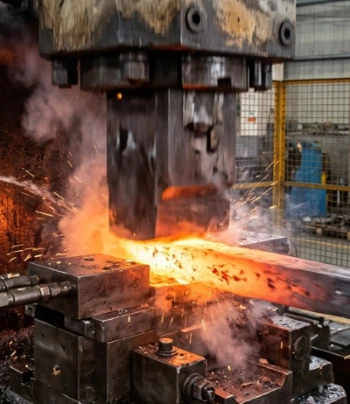
When a hot block is hit during drop forging, the sudden force of compression changes the shape of the metal across its entire cross-section. This compression turns big, as-cast grain structures into smaller, more even grains that spread stress more evenly through the part. Finer grains have shorter lengths between their boundaries, which stop dislocations from moving. This is the microscopic process that causes plastic to break. Drop forging's controlled, repeated impacts smooth out this grain structure in a way that can't be done by any solidification-based process. This gives the finished part a mechanical edge that starts at the microstructural level.
Continuous Grain Flow Following Component Contours
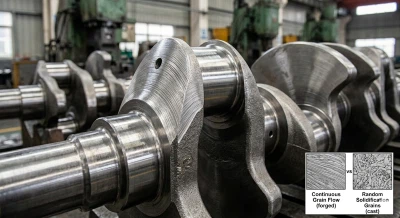
Perhaps the most important structural benefit of drop forging is the way it directs grain flow to match the geometry of the finished part. Unlike machining, which cuts across the grain lines of a wrought billet and exposes weaker cross-sectional grain boundaries at the surface, drop forging shapes the metal so that grain flow runs continuously through and around features like shoulders, flanges, and bends. This means the strongest direction of the metal's grain structure is aligned with the principal drop forging stress directions in service - exactly where strength is needed most. Components like crankshafts, connecting rods, and gear blanks benefit enormously from this characteristic of the drop forging process.
Can Drop Forging Minimise Defects in Metal Grain Structure?
Eliminating Porosity and Shrinkage Cavities
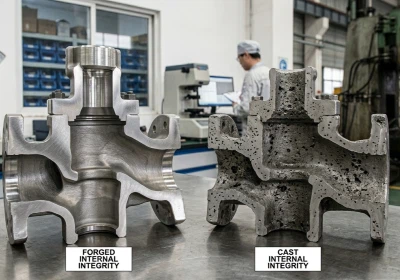
Porosity and shrinkage cavities are risks that come with any process that uses solidification. They happen when molten metal cools unevenly, and gas bubbles or shrinkage voids get stuck inside the solidified structure. This kind of flaw can't happen with drop casting because it uses solid metal instead of liquid metal. Any remaining holes in the original billet are filled with compression forces during drop forging, which seals it shut under pressure. This makes a microstructure that is completely thick and void-free, with no areas of high stress inside that could cause cracking when the structure is loaded. This is one of the main reasons why drop forging is used for important parts that need to hold a lot of pressure in oil and gas, hydraulic systems, and structural uses.
Controlling Inclusions and Segregation Through Deformation
Using heat during drop forging also helps spread out non-metallic particles and lowers any chemical segregation that might have been in the original billet. The thermomechanical energy of the forging process breaks up, and drop forging redistributes long inclusion stringers as the metal deforms. It also evens out concentration differences in alloying elements. Even though there is no way to completely get rid of inclusions, drop forging changes their shape and location so that they are much less dangerous. When combined with high-quality billet feedstock from approved suppliers, this gives drop forging an edge over methods that don't physically work the metal in terms of material integrity.
Drop Forging vs. Casting: Which Produces Superior Metal Integrity?
Microstructural Differences Between Forged and Cast Components
The microstructural differences between drop forging and casting are significant and well-documented. Cast components solidify from a liquid state, and the resulting grain structure is coarse, often dendritic, and susceptible to internal porosity, hot tears, and shrinkage defects. Drop forging, by contrast, mechanically works the metal in its solid state, producing a fine, equiaxed grain structure with continuous grain flow and no solidification defects. Side-by-side comparison of polished and etched cross-sections from forged and cast components of the same alloy makes this difference immediately visible - and the mechanical test data consistently reflect the same story: forged parts are stronger, tougher, and more fatigue-resistant.
Practical Performance Differences in Industrial Applications
In real-life industrial settings, the difference in performance drop forging between casting and drop forging is most noticeable when the load is high-stress, high-cycle, or impact. Cast parts in these conditions are more likely to break while they're being used because of cracks or breaks that start at the edges of large grains. When you drop-forge metal, you get parts that can better absorb impact energy, stop cracks from spreading, and keep their mechanical qualities over a wider temperature range. For use in oil drilling tools, auto safety parts, and space structures-areas where China has a lot of experience, Welong has been helping customers around the world for more than 20 years. The structural stability of drop forging is not just a small improvement; it is often what makes the difference in choosing which parts to use.
Conclusion
In terms of making metal parts with better grain structure stability, drop forging stands out as one of the best methods. It gets rid of solidification flaws, improves grain size, and lines up grain flow with the shape of the part by manually working heated metal under high compressive impact. All of these things make the metal stronger, more durable, and longer-lasting. Industrial buyers and engineers who care about how reliable parts are should work with an experienced, ISO-certified drop forging source like China Welong makes sure that these metal-working benefits are always given.
FAQ
Q1: What metals are most commonly used in drop forging?
A: Carbon steel, alloy steel, and stainless steel are the most widely used materials in drop forging. Aluminium alloys and titanium alloys are also forged for lightweight or corrosion-resistant applications. The choice of alloy depends on the mechanical property requirements, operating environment, and target weight of the finished component.
Q2: How does drop forging differ from press forging?
A: Drop forging uses the kinetic energy of a falling ram or hammer to deliver rapid, high-energy impacts to the workpiece. Press forging applies a slower, sustained compressive force using a mechanical or hydraulic press. Both refine grain structure, but drop forging's impact energy penetrates the cross-section more effectively for certain geometries, while press forging offers more precise control of deformation.
Q3: Is drop forging suitable for high-volume production?
A: Yes. Once tooling is developed and process parameters are established, drop forging is well-suited to high-volume production with consistent part-to-part quality. The process is highly repeatable, and cycle times per piece are short, making it economically viable for production runs in the thousands to millions of pieces.
Q4: Can drop forged parts be used without heat treatment?
A: Some drop forged parts are used in the as-forged condition, but most structural applications benefit from post-forge heat treatment - such as normalising, annealing, quenching and tempering - to optimise the final microstructure and mechanical properties. The specific heat treatment depends on the alloy and the property requirements of the application.
Ready to Source High-Quality Drop Forged Components? Let's Talk
If you need reliable, high-performance drop forged components for your industrial application, China Welong has the expertise and infrastructure to deliver. With over 20 years of experience supplying precision forged drop forging metal parts to clients in the UK, USA, Germany, Australia, and across the globe, we combine ISO 9001-2015 certified quality management with in-house engineering capability using AutoCAD, Pro-Engineering, and SolidWorks. We work from your drawings or samples - or help design them. Reach out today, and let's build something stronger together. Contact us:metal@welongpost.com
References
1. Altan, T., Oh, S., & Gegel, H. (1983). Metal Forming: Fundamentals and Applications. ASM International.
2. ASM International. (2005). ASM Handbook, Volume 14A: Metalworking - Bulk Forming. ASM International.
3. Dieter, G. E. (1988). Mechanical Metallurgy (3rd ed.). McGraw-Hill.
4. Kalpakjian, S., & Schmid, S. R. (2014). Manufacturing Engineering and Technology (7th ed.). Pearson.
5. Groover, M. P. (2020). Fundamentals of Modern Manufacturing: Materials, Processes, and Systems (6th ed.). Wiley.
6. Geiβdörfer, S., Engel, U., & Geiger, M. (2006). FE-Simulations and Analysis of Process Windows for the Forming of Microparts with Grain-Size-Related Effects. International Journal of Machine Tools and Manufacture, 46(11), 1222–1226.


