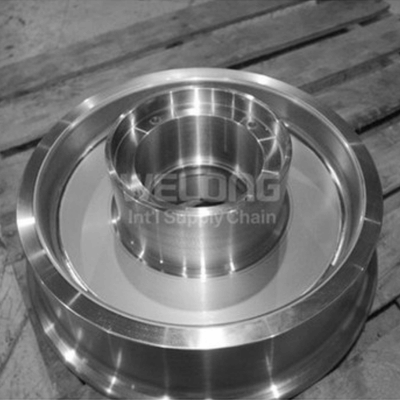

A general term for plastic processing such as cold forging, cold extrusion, and cold heading. Cold forging is a process in which the material is shaped below the recrystallization temperature, and is a forging process performed below the recovery temperature. In the manufacturing process, forging without heating the blank is usually called cold forging. Cold forging materials are mainly aluminum and some alloys, copper and some alloys, low carbon steel, medium carbon steel, and low alloy structural steel with low deformation resistance and excellent plasticity at room temperature. Cold forging has good surface quality and high dimensional accuracy, so it can replace some cutting processes. Cold forging can strengthen metals and increase the strength of parts.

Meaning
Cold forging, also known as cold bulk forming, is a manufacturing process and processing method. It is basically the same as the cold stamping process. The cold forging process also consists of three elements: material, mold, and equipment. The only difference is that the material used in stamping is mainly a plate, while the material used in cold forging is mainly a disk or wire.
In Japan, it is called cold forging (cold forging for short), in China it is called cold heading, and some screw factories also call it heading.
Basic Concept
Cold forging refers to various bulk forming operations that are performed below the recrystallization temperature of the metal. From the theory of metallurgy, we know that the recrystallization temperature of various metal materials is different. Tre = (0.3~0.5) Tmelt. Tmelt is shown in the following table.
Minimum recrystallization temperature of metals/degree Celsius Minimum recrystallization temperature of metals/degree Celsius
Iron (Fe) and copper 360~450 Tin (Sn) 0
Copper (Cu) 200~270 Lead (Pb) 0
Aluminum (Al) 100~150 Tungsten (W) 1200
The numbers in the table show the minimum recrystallization temperature of ferrous metals and nonmetals. The forming process of lead and tin can be called hot forging, not cold forging, even at room temperature. However, the process of forming iron, copper and aluminum at room temperature can be called cold forging.
The shapes of cold forged parts are becoming more and more complex, from the early stepped shafts, screws, nuts and conduits to parts with complex shapes.
The general process of splined shafts is forward extrusion of the rod part - upsetting of the middle head part - extrusion of the spline.
The main processes of splined sleeves are reverse extrusion of the cup-shaped part, punching the bottom to create a ring-shaped part, and forward extrusion of the shaft sleeve.
Cylindrical gear cold extrusion technology has also been successfully used in production. In addition to ferrous metals, cold extrusion of copper alloys, magnesium alloys and aluminum alloys has also become increasingly widely used.
Application
The rapid development of the current automobile industry, motorcycle industry and machine tool industry has become the driving force behind the development of the traditional technology of cold forging. For example, in 1999, the total domestic production of motorcycles in our country exceeded 11.26 million units. According to provisional estimates in 2000, the total demand for automobiles in our country is expected to reach 3.3 million units by 2005, of which 1.3 to 1.4 million sedans are expected. In the automobile industry alone, the demand for forged products is expected to exceed 500,000 to 600,000 tons. Although cold forging technology in our country has not started very slowly, the speed of development is far behind developed countries. To date, the weight of cold forged products in automobiles produced in our country is less than 20 kg, which is half that of developed countries, and the development potential is great. Strengthening the development and promotion of cold forging technology is an urgent task for our country.
Technology introduction
Technology
Cold forging is a (nearly) net-shape forming process. Parts formed by this method have high strength, high precision and good surface quality. At present, the total weight of cold forged parts used in general foreign cars is 40 to 45 kg, of which the total weight of gear parts is more than 10 kg. The weight of one cold forged gear exceeds 1kg, and the tooth profile precision reaches level 7.
Continuous process innovation has promoted the development of cold extrusion technology, and since the 1980s, precision forging experts at home and abroad have begun to apply split flow forging theory to the cold forging of spur gears and helical gears. The main principle of conversion forging is to establish a conversion cavity or conversion channel of material in the forming part of the blank or die. During the forging process, while the material is filling the cavity, part of the material flows into the conversion cavity or conversion channel. The application of split flow forging technology has enabled the low-cutting and no-cutting processing of high-precision gears to rapidly reach industrial scale. For extrusion parts with a length-to-diameter ratio of 5, such as piston pins, the use of an axial surplus block with a wide axial deflection can realize cold extrusion forming in one step, and the punch stability is very good. For the forming of spur gears, the use of a radial surplus block can also realize cold extrusion forming of the product.
Closed forging is a one-time forming process in which metal is extruded in one or two directions by one or two punches in a closed die to obtain a precision forging with nearly net shape without burrs. Cutting some precision automotive parts, such as planetary gears and half axle gears, star sleeves, and cross bearings, not only results in very low material utilization (less than 40% on average), but also takes time and the production costs are extremely high. Overseas, closed forging technology is used to produce these net shape forgings, which omits most cutting processes and greatly reduces costs.
Technical requirements
Cold forging
The forming accuracy of cold forging technology is higher than that of warm forging and hot forging, and it has its own advantages in the field of precision forming. The adoption of cold forging technology can improve the smoothness, dimensional accuracy, and surface strength of the inside of the barrel, extend the life of the barrel, and accordingly improve the shooting accuracy of the gun. It also makes it easier to process tapered barrels and reduce their weight. The cold forging method was first proposed by Steyr, and Steyr's cold forging machines were subsequently adopted by countries around the world for use in processing gun barrels.