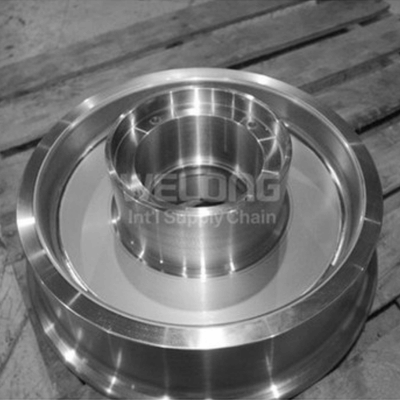

The forging process carried out above the recrystallization temperature of the metal is called hot forging. Hot forging is also called hot die forging. During forging, the deformed metal flows vigorously, and the contact time between the forging and the die is relatively long. Therefore, the die material is required to have high thermal stability, high-temperature strength and hardness, impact toughness, thermal fatigue resistance, wear resistance, and be easy to process. Hot forging dies for lighter workloads can be made of low-alloy steel.
Cutting method
Except for large and medium-sized free forgings that use steel ingots as blanks, general forgings use various metal bars as blanks. Before forging, the bar material is usually cut according to the required size with a special blanking device. Commonly used blanking methods are:
Sawing
Sawing is often done with circular saws, bow saws, and high-speed band saws.
Circular saws are motor-driven saws with teeth that move slowly while rotating to cut the bar material. The maximum diameter of the saw can reach 2m, and the diameter of the bar that can be sawed is less than 750mm.
The bow saw is a motor that cuts bar material by moving a toothed saw blade back and forth. The diameter of the bar that can be cut is less than 100 mm. Especially bars with small diameters can be cut in bundles.
The characteristic of sawing is that the cross section is smooth and the size is accurate. However, the productivity is low, there is saw cutting loss, and the saw blade and saw machine are also relatively large. The high-speed band saw is a more advanced cutting device with high production efficiency and uniform shape of the blank.
Cut
Shearing is usually performed with a shearing machine that can shear steel billets with a diameter of less than 200 mm. When steel pieces are cold sheared, large stress is generated in the sheared part, causing cracks. Therefore, high carbon steel, alloy steel, and steel pieces with large cross-sectional dimensions must be preheated to 350-700 ° C before shearing. Low carbon steel, medium carbon steel, and other steel pieces with small cross-sectional dimensions can be cold sheared.
The characteristic of the shearing machine is that it can be equipped with an automatic feeding and discharging mechanism. This improves the working environment of workers, improves production efficiency, saves metal, and increases the utilization rate of materials. However, the sheared end surface is uneven and slightly distorted, which is even more serious when shearing large-diameter steel billets in a hot state. Shearing machines are widely used in die forging factories for mass production.
Shearing can also be done with trimming punches, friction presses and other devices.
Fracturing and cutting
Fracturing and cutting are done with hydraulic presses or crank presses. Pressure is transmitted to the material through the punch, causing the material to break along the pre-cut part. The principle is shown in Figure 1. Before breaking, pre-cutting is usually done by sawing or gas cutting. The purpose is to create a large stress concentration in the cut part so that when the material breaks at a certain position, it does not cause large plastic deformation, which affects the quality of the cross section. Figure 1 Fracturing principle
Fracturing is suitable for high carbon steels and high-alloy steels with high hardness. For bearing steels such as GCr15, GCr15SiMn, GSiMnMo, and GSiMnV, the heating temperature is 300-400°C.
Abrasive wheel cutting
Abrasive wheel cutting is performed with an abrasive wheel cutting machine. The abrasive wheel cutting machine rotates a thin grinding wheel (generally less than 3 mm thick) at high speed driven by an electric motor, and moves it up and down manually or mechanically to cut the steel piece. The abrasive wheel cutting machine can cut metal blanks of any hardness with a diameter of less than 40 mm.
The characteristics of abrasive wheel cutting are high productivity and smooth cutting surface. However, the loss of thin grinding wheels is large, the working environment of the operator is poor, and good ventilation facilities are required.
Flame cutting
Flame cutting is also called gas cutting. The principle is to use a gas cutter or a normal welding gun to locally heat the steel to the melting temperature with a flow of oxygen and gradually melt it. It is mainly used for large cross-section cutting of large steel billets and forgings (the thickness of the cut part can reach 1500mm or more), and can also be used for trimming large die forgings produced in small batches.
Anode cutting
The principle is to use electric corrosion and electrochemical corrosion to cut metal materials. The size of the cut material is 30-300mm. The characteristics of anodic cutting are high productivity, low waste, and the ability to cut metal materials of any hardness with a smooth cross section.