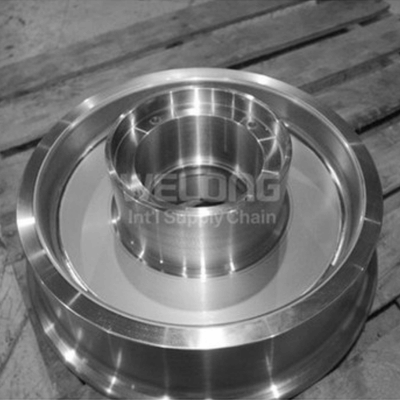

Purpose and method of hot forging
The purpose of heating metal blanks before forging is to improve the plasticity of metal, reduce the deformation resistance, increase the fluidity and formability, and obtain a good structure after forging. Therefore, heating before forging has a direct effect on improving forging productivity, ensuring forging quality, and saving energy consumption. According to the heat source used, the heating method of metal blanks is divided into two categories: flame heating and electric heating.
Flame heating
Flame heating is performed by burning fuel (coal, coke, heavy oil, light oil, gas) in a flame heating furnace to generate high-temperature gas (flame) containing a large amount of thermal energy, which is transferred to the surface of the blank by convection and radiation, and the metal blank is heated by conducting heat from the surface to the center.
When the heating temperature is below 600-700 ° C, the heating of the blank mainly relies on convection heat transfer. The so-called convection heat transfer transfers heat energy to the metal blank by a flame flowing continuously around the metal blank and heat exchange between the hot gas and the blank surface. When the heating temperature exceeds 700-800 ° C, the heating of the blank is mainly based on radiation heat transfer. The so-called radiation heat transfer is to convert thermal energy into radiation energy through hot gas and furnace. The radiation energy transferred in the form of electric microwaves is absorbed by the metal blank and converted into thermal energy to heat the blank. When a normal forging heating furnace is heated at high temperature, radiation heat transfer accounts for more than 90%, and convection heat transfer accounts for only 8%-10%.
The advantages of the flame heating method are convenient fuel source, simple furnace structure, low heating cost, wide range of blank adaptation, etc. However, the working conditions are poor, the heating rate is slow, the efficiency is low, and the heating quality is difficult to control. This heating method is widely used for heating various blanks.
Electric heating
Electric heating converts electrical energy into thermal energy to heat the metal blank. These include induction heating, contact heating, resistance furnace heating, and salt bath furnace heating.
1. Induction heating
The action of the alternating magnetic field generated by the alternating current passing through the inductor generates alternating eddy currents inside the metal blank. The eddy currents and magnetization heating (below the magnetic transition point) directly heat the metal blank.
When the blank is induction heated, the current density generated inside is distributed unevenly along the cross section, with a small current density in the center and a large current density on the surface. This phenomenon is called the skin effect. Therefore, the metal on the surface is mainly heated by the passage of current, and the metal in the core is heated by heat conduction from the outer layer to the inside. For large-diameter blanks, to increase the heating rate, a low current frequency must be selected to increase the current penetration depth. On the other hand, for small-diameter blanks, due to the small cross-sectional size, a high current frequency can be used, which can improve electrical efficiency.
2. Contact electric heating
The principle of contact electric heating is to pass a low-voltage, high current directly through the metal blank. Since metal has a certain resistance, heat is generated when the current passes through it, and the metal is heated.
To heat a blank of a certain size to a specified temperature, a certain amount of heat must be generated. Since the resistance value of ordinary metals is relatively small, a large current must be passed through the blank to improve productivity and shorten the heating time. In order to avoid short circuits, the voltage is often reduced to obtain a high current at a low voltage. Therefore, the no-load voltage at the secondary end of the transformer used for contact electric heating is only 2 to 15 V.
The characteristics of contact electric heating are fast heating rate, little metal burning, unlimited heating temperature range, high thermal efficiency, low power consumption, low cost, simple equipment, and easy operation. However, strict requirements are imposed on the surface roughness, shape, and size of the blank, especially the end of the blank must be uniform and distortion-free. It is also difficult to measure and control the heating temperature. It is suitable for full or partial heating of long blanks.
Determination of range
Hot forging is carried out within a certain temperature range. The forging temperature range of steel refers to the temperature interval between the forging start temperature (initial forging temperature) and the forging end temperature (final forging temperature).
The basic principle of determining the forging temperature range is to increase the plasticity of steel and reduce the deformation resistance to obtain high-quality forgings. At the same time, the forging temperature range should be as wide as possible to reduce the number of heating times and improve forging productivity.
The basic method of determining the forging temperature range is to refer to the steel's plasticity diagram, resistance diagram and recrystallization diagram on the basis of the steel's equilibrium diagram, comprehensively analyze the plasticity, quality and deformation resistance to determine the initial forging temperature and the final forging temperature.
In general, the forging temperature range of carbon steel can be directly determined based on the iron-carbon equilibrium diagram. For the forging temperature range of most alloy structural steels, carbon steel with the same carbon content can be considered as the basis. However, for high-alloy steels with low plasticity and steels that do not undergo phase change (such as austenitic steels and pure ferritic steels), experiments are required to determine the appropriate forging temperature range.