


Metal forming and rolling mill processes need accuracy and uniformity. The guide roll is a key component that enables both. Guide rollers at rolling line entrance and departure points accurately lead material through each pass, prevent lateral deviation, and protect the workpiece and mill from misalignment. The guide roll quietly keeps production on schedule while hot-rolling steel billets, cold-rolling aluminum sheet, or drawing wire and tube products. Guide rollers are used in many rolling operations, and this article illustrates why good selection and design are crucial to mill performance.
Controlling Material Alignment and Precision in Rolling Mills
Entry and Exit Guidance for Accurate Pass Alignment
Guide rolls place arriving workpieces appropriately before they reach the roll gap at the entrance side of each rolling stand. A slight entrance point variation might cause off-center rolling, uneven cross-section, or surface flaws that spread over consecutive passes. A good guide roll assembly keeps the material on the centerline and lets it roll smoothly. Guide rollers on the exit side collect the emerging product and send it to the next stand or coiling station without twisting or lateral wander. Modern rolling mills maintain tight dimensional tolerances over lengthy production runs because of synchronized entrance and exit guidance.
Stabilizing Twist and Camber in Continuous Rolling Lines
In continuous rolling lines with many stands running at high speed, workpiece twisting or camber between passes must be instantly controlled. Guide roll assemblies between stands passively counteract these tendencies by constraining the material's rotation and lateral movement with their groove or housing shape. Angles, channels, and rounds need specially designed guide rollers to align the product in the following stand. This passive alignment capability is essential in high-speed rod and bar mills where human pass correction is impossible.
Reducing Wear and Tear Through Proper Guide Roll Selection
Material Selection for Guide Rolls in High-Temperature Applications
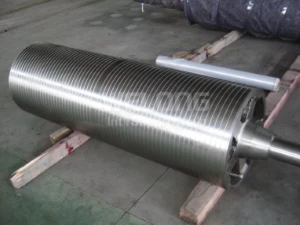
Guide rollers are subjected to high temperatures, scale particles, and workpiece mechanical contact stresses during hot-rolling. The groove profile's dimensional stability and service life depend on choosing the correct guide roll material under these circumstances. High-alloy tool steels, wear-resistant cast irons, and carbide-reinforced materials are employed depending on rolling temperature, material, and manufacturing volume. Unsuitable guide rolls wear quickly, changing groove geometry and reducing alignment function. Proper material selection from the start reduces changeovers and maintains rolling line quality.
Bearing and Mounting Design to Minimize Mechanical Fatigue
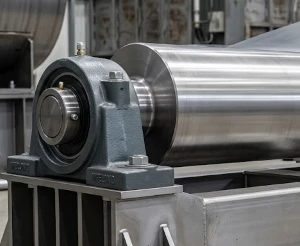
Guide rolls' bearing arrangement, mounting method, and roll body quality affect their durability. Under load, improperly supported guide rolls deflect, providing uneven contact across the roll face and exacerbating localized wear. High-quality guide roll assemblies feature precise bearings and durable housings to ensure roll placement throughout the service life. Proper housing alignment, lubrication, and preload are crucial during installation. Guide roll assemblies function consistently over lengthy service intervals when these elements are controlled properly, minimizing roll replacements and production disruptions.
Enhancing Production Efficiency with Optimized Guide Roll Configurations
Quick-Change Guide Systems for Reduced Changeover Time
To match product geometry, rolling mills with several product sizes and sections must replace guide rolls often. Minimizing guide roll assembly switch time is an efficiency goal since every hour spent on changeover is wasted productivity. Modern cassette-style housings, standardized mounting interfaces, and pre-set adjustment mechanisms enable operators to replace guide rolls in a fraction of the time needed by previous designs. These methods, when used with accurate pre-setting equipment offline, guarantee that the new guide roll assembly runs at the right pass line height and centerline position when installed, avoiding the time-consuming fine-tuning of previous designs.
Optimizing Pass Schedules Around Guide Roll Performance
How pass schedule design affects guide roll performance is commonly disregarded in rolling mill optimization. Overly severe reductions in one pass might accelerate guide roll wear and failure by applying high lateral pressures. Mill engineers may improve guide roll service life while maintaining productivity by spreading reduction more equally between passes and structuring the pass schedule with guide roll load limitations in mind. China WELONG uses systems thinking to supply customized rolling mill components, working with customers to understand their full production context and deliver guide roll solutions and component packages that optimize the entire rolling process rather than just one piece of equipment.
Adapting Guide Rolls for Different Materials and Rolling Applications
Guide Rolls for Steel, Aluminum, and Non-Ferrous Rolling
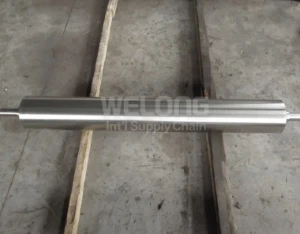
Different metals roll differently; therefore, the guide roll must match the material being treated. Guide roll materials and coatings must endure thermal cycling and severe wear due to steel's high rolling temperatures and abrasive scale. Aluminum is softer and more likely to mark; therefore, guide rollers with smooth, polished contact surfaces and non-ferrous or polymer-lined groove profiles avoid material pickup and transfer. Copper and its alloys need guide roll designs that reduce friction to avoid surface scoring on the delicate workpiece surface. A good guide roll provider knows material-specific needs and supplies goods for each application.
Specialized Guide Roll Applications in Tube, Wire, and Section Rolling
Guide rolls are needed in tube mills, wire drawing lines, and section rolling because the workpiece's three-dimensional form requires accurate guiding on many axes. As tubes pass through reducing and sizing stands, guide rollers preserve roundness and concentricity. Guide rollers at high speeds in wire rod mills must be dynamically balanced and precisely positioned to minimize vibration that might produce wire surface defects or dimensional variation. Complex profile section rolling requires custom-profiled guide rolls that fit the product's cross-section at each pass. With its excellent customized capabilities and 20 years of industrial component manufacturing expertise, China Welong can provide guide roll solutions for this wide variety of specific applications.
Conclusion
Guide rolls regulate alignment in high-speed rod mills and adapt to aluminum and tube rolling, making them easy to overlook and expensive to neglect. Application-specific guide rolls-material, profile, bearing arrangement, and mounting system-impact product quality, mill uptime, and operating cost. China Welong's production knowledge, quality processes, and customisation allow rolling mill operators to make the correct decision every time.
FAQ
Q1: How do I choose the right guide roll material for my rolling application?
Guide roll material depends on rolling temperature, material being processed, and estimated production volume between roll changes. High-alloy tool steels or wear-resistant cast irons are recommended for hot-rolling steel due to their hardness and heat stability. Cold-rolling or aluminum applications benefit from better surface finishes and reduced friction, including polymer-lined alternatives, which avoid surface marking on delicate workpieces. The best approach to determine material specification is to consult with an experienced guide roll provider who can assess your rolling circumstances.
Q2: How often should guide rolls be replaced in a rolling mill?
Rolling speed, reduction per pass, material, lubrication and cooling, and guide roll quality affect guide roll replacement frequency. Guide rolls may be replaced every few hours in high-speed rod mills, although slower bar and section mills may last many shifts. Groove wear, surface quality, and product dimensional correctness are the best indications of guide roll replacement. Regular inspection and pre-setting reduce unnecessary stoppages and maintain rolling line quality.
Q3: Can China Welong supply custom guide rolls for non-standard profiles?
Yes, China. Guide rollers for non-standard section profiles, tube applications, and unique rolling lines are part of Welong's customized industrial and oilfield equipment. With drawings, sample profiles, or technical requirements, Welong's production staff can create guide rollers to the precise shape needed. Full dimensional inspection and documentation are performed on all custom guide roll products under ISO 9001:2015 quality management. Flexible trade terms and sea, air, and train transportation enable quick delivery globally.
Need High-Quality Guide Rolls for Your Rolling Line? Contact China Welong Today
Whether you need standard guide roll assemblies or fully customized solutions for a specialized rolling application, China Welong has the manufacturing capability and industry experience to deliver. Backed by ISO 9001:2015 certification, over 20 years of production expertise, and a commitment to on-time delivery through flexible global logistics, we are the supply chain partner your rolling operation can rely on. Send us your specifications and let us help you find the right guide roll solution for your process. Contact us today at:metal@welongpost.com.
References
1. Bhadeshia, H. K. D. H., & Honeycombe, R. W. K. (2017). Steels: Microstructure and Properties (4th ed.). Butterworth-Heinemann.
2. Ginzburg, V. B. (1989). Steel-Rolling Technology: Theory and Practice. Marcel Dekker.
3. Lenard, J. G. (Ed.). (2007). Primer on Flat Rolling (1st ed.). Elsevier Science.
4. Roberts, W. L. (1983). Hot Rolling of Steel. Marcel Dekker.
5. Schey, J. A. (2000). Introduction to Manufacturing Processes (3rd ed.). McGraw-Hill.
6. Wright, R. N. (2011). Wire Technology: Process Engineering and Metallurgy. Butterworth-Heinemann.


