


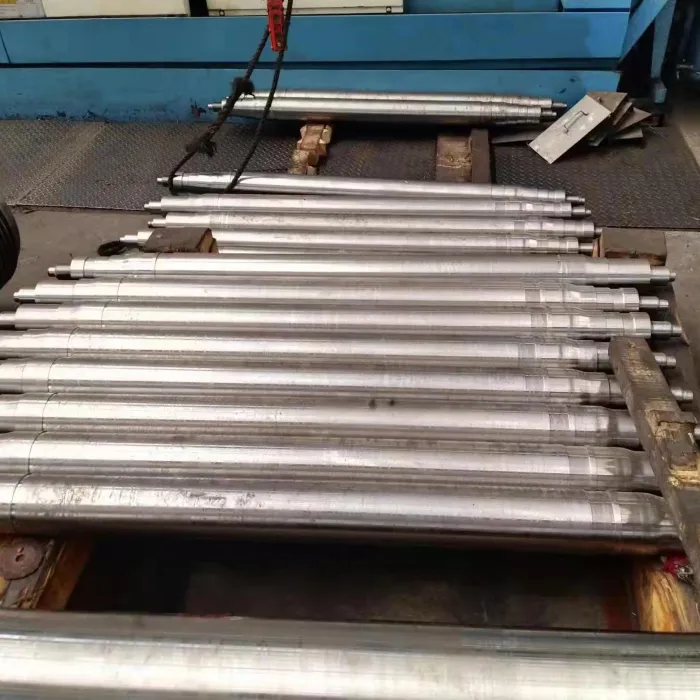

What is Forged Shaft
A forged shaft is a mechanical component that has been manufactured through the forging process, which involves the shaping of metal using localized compressive forces. Forging can be done either hot (where the metal is heated to a high temperature), warm, or cold. This process can improve both the strength and the grain structure of the metal, making the shaft more durable and resistant to failure under stress.
Free Forging
Free forging is a processing method that involves using simple universal tools or directly applying external force to deform a blank between the upper and lower anvil of forging equipment, to obtain the required geometry and internal quality.Forgings produced through this method are known as free forgings and are typically produced in small batches.
Die Forging
Die forging can be categorized into two main types: open-die forging and closed-die forging. During this process, a metal blank is deformed and pressed in a forging die chamber of a specific shape to create forgings.Typically, die forging is used to manufacture parts with small weights and in large batches. This process can be further divided into three types: hot die forging, warm forging, and cold forging.
Grinding Ring
Ring grinding is the process of producing ring parts with varying diameters using specialized equipment, known as a ring grinding machine. It is also utilized in the production of wheel parts, including automobile hubs and train wheels.
Special Forging
Special forging techniques include roll forging, cross wedge rolling, radial forging, liquid die forging, and other methods that are better suited for producing certain complex-shaped parts.Roll forging, for instance, can serve as an efficient pre-forming process that significantly reduces the amount of pressure required for subsequent forming operations.
Forging Die
According to the movement mode of the forging die, forging can be divided into swing rolling, swing rotary forging, roll forging, cross wedge rolling, ring rolling, and cross rolling.Rotary forging, rotary forging, and ring rolling can also be processed by precision forging.In order to improve the utilization of materials, roll forging and cross-rolling can be used as the previous process for slender materials.


Forged Shaft Manufacturing Process
Material Selection
Before manufacturing shaft forgings, the selection of materials is very important. It is necessary to select high-quality steel as raw materials according to the demand for shafts to ensure the durability, wear resistance and various mechanical properties of shaft forgings.
Preheating
Preheating is one of the indispensable links in the forged shaft manufacturing process and plays an important role. Put the cleaned raw materials into the furnace for preheating, so that the temperature reaches the required temperature uniformly. Different types of shafts have different preheating times, for example: fan shaft forgings, the first preheating is 800°C, the second preheating is 500-650°C and 850°C; the gear shaft needs to be heated to 950°C ℃ or so. The final preheating temperature and time depend on the performance and material requirements of the forged shaft. The main purpose of the preheating process is to reduce the internal stress of the material, improve the deformation capacity, improve the plasticity of the metal, improve the forging efficiency and quality, and ensure the forming quality and performance of the forged parts.
Forging
The forging process of shaft forging is a high-strength forging manufacturing technology, and it is also the most important link in the forged shaft manufacturing process. After the material is taken out of the preheating furnace, it is cooled to a temperature range suitable for forging to avoid hot cracking or hot embrittlement, and then forging is carried out. The traditional forging process of forging shaft includes cold forging and hot forging. Cold forging can strengthen the metal, improve the surface quality, and maintain the hardness and strength of the material. The process is generally processed at room temperature; the hot forging process is processed at a temperature higher than the recrystallization temperature of the blank metal, and the temperature is higher than 800 ° C, that is Forging at high temperature, using this process, can reduce the deformation resistance of the metal and improve the plasticity and toughness of the material.
Heat Treatment Process
The heat treatment process is carried out after forging, and is also a necessary link in the forged shaft manufacturing process. The heat treatment process mainly includes two processes: heating and cooling. The forged shaft is heated, and after reaching a certain temperature, it is cooled. The heat treatment of the forged shaft can eliminate the stress generated in the forging process and improve the structure and performance of the shaft.
Machining Process
Machining is an important process in the manufacturing process of forged shafts, including turning, grinding, milling, drilling, EDM, etc. Machining processes can make the shaft forgings meet the precision requirements and ensure the surface quality.
Surface Treatment Process
This process is the last step in the forged shaft manufacturing process, including grinding, polishing, sandblasting, spraying, etc. The specific selection process is based on customer requirements. The purpose of surface treatment is to remove impurities such as oxides, rust, and burrs on the surface of the shaft forgings to make the surface smooth and flat, and at the same time improve the corrosion resistance and aesthetics of the shaft forgings.
Material Properties
The material of forged shafts is relatively uniform, has high toughness and strength, and can withstand large stress and impact loads; while the material of quenched and tempered shafts is relatively brittle, but has higher hardness and wear resistance.
Processing Method
Forged shafts are formed by pressing metal at high temperatures, so they can form complex geometric shapes; quenched and tempered shafts adjust their properties through heating and cooling control, and then cut into shape.
Scope of Application
Forged shafts are suitable for high-strength, high-toughness, and high-corrosion-resistant mechanical equipment, such as automobiles, ships, aircraft, etc.; quenched and tempered shafts are suitable for high-hardness, high-wear-resistant mechanical equipment, such as drilling, grinding, etc.

Frequently Asked Questions
Hot Tags: forged shaft, China forged shaft manufacturers, suppliers, factory, leading forging companies, Forging Services, Anti-creepers, Closed Die Forging Process, Spike Puller Claw, Forging