


The success or failure of a large-scale metal component project may be directly correlated to the manufacturing partner that is selected. In order to source bespoke parts, buyers need to thoroughly analyse open die forging companies. They should go beyond pricing alone to consider certifications, technical aptitude, equipment capacity, and long-term dependability. This article provides an overview of the most important considerations that procurement teams and engineers want to take into account when choosing a supplier that is capable of providing quality that is consistent across demanding industrial applications.
What Certifications Should Open Die Forging Companies Have?
ISO 9001 Quality Management Certification
Determine whether or not a supplier is certified to the ISO 9001 standard. This is one of the first things that purchasers should check. The implementation of this standard verifies that open die forging enterprises adhere to defined quality control systems that encompass all aspects of the process, from the examination of incoming materials to the release of assembled parts. Buyers are exposed to a larger risk of inconsistent output, unrecorded process variances, and difficulties in tracking faults back to their source cause if they do not possess this baseline certification.
Industry-Specific Compliance Standards
Additionally, customers may want suppliers that possess other certifications, such as API for oil drilling components or AS9100 for aerospace parts, depending on the application that will ultimately be used. General manufacturing certificates do not completely address the documentation, traceability, and testing requirements that are more stringent. Reputable open die forging businesses often maintain various industry-specific credentials, which demonstrate their ability to satisfy these standards.
Material Traceability Documentation
In addition, proper certification of open die forging companies requires the maintenance of complete material traceability, beginning with mill certifications and continuing until final shipping. It is important for purchasers to verify that open die forging firms are able to provide comprehensive information on chemical composition, mechanical test findings, and heat treatment records for each and every batch that is manufactured. Not only does this paperwork safeguard purchasers during audits, but it also offers essential proof in the event that a component ever has to be tracked down for quality inspection purposes.
How Do You Evaluate Forging Capacity and Material Expertise?
Press Tonnage and Equipment Range
There is a substantial amount of variation in forging capacity across suppliers; thus, purchasers need to verify that the press tonnage of a business is compatible with the part size requirements they have. Established open die forging enterprises often employ a variety of presses and hammers, which enables them to handle a wide range of components, from tiny precision components to enormous shafts and rings, without having to outsource crucial activities to third parties.
Alloy and Metal Grade Experience
There are certain suppliers that do not have extensive expertise dealing with all of the alloy families. It is important for purchasers to enquire explicitly about a company's track record with carbon steel, alloy steel, stainless steel, and speciality metals that are pertinent to their application. Open die forging businesses that have years of experience in the field may provide guidance on grade selection, forging temperature ranges, and grain flow optimisation based on their years of accumulated production experience.
Engineering and Design Support
Strong suppliers give more than simply manufacturing; they also provide engineering assistance throughout the design phase of the project. When buyers deal with open die forging firms that utilise computer-aided design (CAD) and simulation software like SolidWorks or Pro-Engineering, they reap the benefits of this arrangement. This is because it enables the identification of any flaws or inefficiencies prior to the beginning of physical production, which saves both time and money on material expenses.
What Machining and Heat Treatment Capabilities Should Buyers Check?
In-House Machining Services
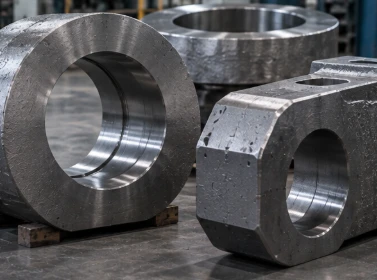
A significant number of purchasers prefer open die forging companies that provide machining in addition to forging since this decreases the complexity of logistics and shortens the total lead time. Companies that specialise in open die forging and have in-house CNC machining skills are able to produce near-net-shape or completely completed parts directly. This eliminates the coordination issues and quality concerns that are associated with managing numerous distinct suppliers for a single component.
Heat Treatment and Metallurgical Testing
It is important for customers to verify the furnace types and treatment techniques that a supplier provides, such as normalising, quenching, and tempering, since heat treatment has a direct impact on the mechanical qualities of forged parts. In addition, dependable open die forging firms have laboratories in-house or in close partnership with other businesses for the purpose of conducting hardness testing, tensile testing, and microstructure analysis to ensure that the treated parts are up to the required specifications.
Non-Destructive Testing Capabilities
When it comes to identifying internal or surface flaws, non-destructive testing methods like ultrasonic inspection, magnetic particle testing, or dye penetrant testing are often needed for applications that are considered to be of essential importance. In order to avoid delays and extra coordination risk in the production schedule, buyers should enquire about the NDT techniques that possible open die forging businesses provide in-house. This is because outsourcing this phase might introduce delays and additional coordination risk.
How Can Buyers Compare Cost, Lead Time, and Supplier Reliability?
Transparent Pricing Structures
There is a need for cost comparisons to go beyond just comparing costs on a per-part basis at all. It is essential for purchasers to make a request to open die forging companies, requesting that they offer a breakdown of pricing for raw materials, tooling, machining, and testing. By doing so, purchasers will be able to ascertain the areas in which value is being added and the areas in which hidden expenses may become apparent in the future. An additional benefit of transparent quoting is that it makes it easier to compare various suppliers on an equal basis. This is a significant advantage.
Realistic Lead Time Commitments
A significant factor that distinguishes reputable suppliers from inferior ones is their level of dependability with regard to the lead time. Buyers who are considering making a purchase should ask about the typical production schedules, the current capacity utilisation, and the method in which open die forging companies cope with unanticipated delays, such as shortages of supplies or downtime for equipment. There is a tendency for suppliers that have a high level of scheduling discipline to provide more consistent results across a number of different customers' orders.
Track Record and Customer References
In conclusion, prospective buyers should query about references or case studies from existing customers, particularly those who are operating in industries that are similar to their own. Open die forging companies have a variety of compelling reasons to be trusted with high-value manufacturing projects that are expected to last for an extended period of time. The presence of a long operating history, documented exports to a number of countries, and repeat business from established manufacturers are all characteristics that contribute to profitability.
Conclusion
For the purpose of selecting the most suitable open die forging company partner, it is necessary to evaluate certifications, equipment capacity, machining capabilities, and supplier dependability in conjunction with one another rather than separately. Since its founding in 2001 and subsequent certification to the ISO 9001:2015 standard, China Welong has spent the last twenty years catering to clients in the automotive, aerospace, oil drilling, and medical industries in over a dozen different countries as one of the trusted open die forging companies. Are you prepared to work with a trustworthy forging partner? Today is the day to talk about the requirements for your project.
FAQ
What size components can open die forging companies typically produce?
Capabilities vary by supplier, but many handle parts ranging from small precision shafts to large rings and blocks weighing several tons.
Why is ISO 9001 certification important when choosing a forging supplier?
It confirms the company follows documented quality management processes, reducing the risk of inconsistent output and undocumented defects.
Do open die forging companies also offer machining services?
Many established suppliers provide in-house CNC machining, allowing them to deliver finished or near-net-shape parts directly.
What testing methods confirm forged part quality?
Common methods include ultrasonic testing, magnetic particle inspection, tensile testing, and hardness testing depending on application requirements.
How can buyers reduce lead time risk with a new supplier?
Requesting references, reviewing past delivery performance, and confirming current production capacity all help reduce scheduling uncertainty.
Partner With a Trusted Open Die Forging Supplier
If you're evaluating open die forging companies for your next project, China Welong offers 20 years of proven experience, ISO 9001:2015 certification, and engineering support using AutoCAD, Pro-Engineering, and SolidWorks. We've shipped custom forged components to customers across the UK, USA, Germany, Australia, and beyond. Contact us today at metal@welongpost.com to discuss your specifications and receive a detailed quote.
References
1. American Forge and Foundry Association, Open Die Forging Design Guidelines, Industry Technical Handbook.
2. ASM International, Forging Handbook, ASM International Publications.
3. Forging Industry Association (FIA), Custom Forged Products Buyer's Guide, FIA Technical Series.
4. International Organization for Standardization, ISO 9001:2015 Quality Management Systems Requirements.
5. American Petroleum Institute (API), API Specification Q1: Quality Management System Requirements for Manufacturing Organizations.
6. Society of Automotive Engineers (SAE International), Metals Engineering and Forging Applications Handbook.


