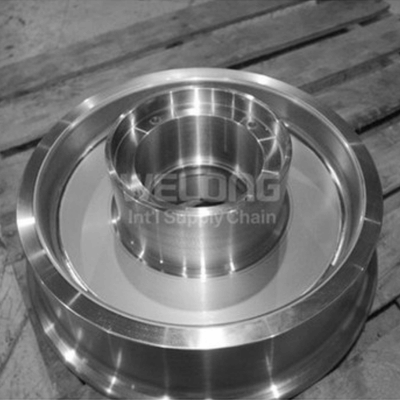

Gravity casting, also known as permanent mold casting, is a common metal casting process using reusable metal molds. It offers benefits like good dimensional accuracy, excellent surface finish, and consistent properties for medium to high production volumes. it and forging are two very distinct manufacturing processes for metal components.
Here we examine the gravity method, its advantages, and how it compares to the forging process.
What Is Gravity Casting?
In gravity casting, molten metal is poured into an open-top permanent mold typically made from cast iron or steel. The mold cavity has the shape of the desired finished part. Gravity alone fills the mold, without applied pressure. As the metal solidifies in contact with the metal mold walls, heat transfers very evenly to yield fine-grained castings.
Once the casting has fully solidified, the mold halves are opened and the part is removed. The molds are reused repeatedly in this process, allowing high production volumes. it excels at complex geometries and can provide high dimensional accuracy and surface quality.
It is suited for metals with good fluidity like aluminum, copper, magnesium, and zinc alloys. Ferrous alloys can also be gravity cast but may require mold coatings to prevent erosion. At China Welong Foundry, we leverage precision service to produce quality metal components across a wide range of industries.
Benefits
There are many advantages that make it a popular production method:
- Reusable metal molds allow high volumes at lower costs
- Rapid heat transfer from the mold produces fine grain structures
- Consistent properties and microstructure using fixed molds
- Near net shape castings reduce machining
- Excellent surface finish down to RMS 63 microns
- Good dimensional accuracy around ±0.5% of tolerances
- Handles complex part geometries with thin walls and details
- Wide range of metals can be cast to tight tolerances
- Minimal gas porosity defects due to open molds
For medium to high production runs of 500 units or more, it provides an optimal balance of quality, consistency, and cost-effectiveness. China Welong Foundry has extensive expertise utilizing it to manufacture quality metal components that meet your exact specifications.
How Gravity Casting Compares to Forging
Plastic deformation processes like forging form metal by applying localized compressive forces, in contrast to casting's filling of a mold. There are some key differences:
- Castings pour into shapes, forgings deform into shapes
- Castings can form complex contours difficult to forge
- Forgings exhibit directional properties from metal flow
- Castings have more uniform properties in all directions
- Forgings produce no porosity defects unlike castings
- Castings offer closer dimensional tolerances
- Castings have lower tooling costs for lower volumes
- Forgings have higher strength and ductility than castings
- Forgings require more secondary machining than castings
In general, forging makes sense for higher strength requirements, while casting is ideal for complex, detailed geometries. At China Welong Foundry, we can deliver the benefits of precision gravity casting or quality forged components based on each customer's specific application needs.
Recent Advances
Ongoing casting research provides valuable insights into further improving quality and capabilities:
- Computer simulation of solidification predicts potential defects in castings (Pan et al, 2019)
- Inline quality inspection like x-ray or 3D scanning detects defects right after casting (Yuan et al, 2019)
- New coatings on permanent molds increase wear resistance and surface finish (Tang et al, 2020)
- Advanced aluminum alloys like Al-Ce offer superior strength and corrosion resistance (Shaha et al, 2019)
- 3D printed sand molds enable more complex part geometries (Li et al, 2020)
- Automated pouring, shakeout, and inspection improve productivity and consistency (He et al, 2020)
At China Welong, we continuously research and adopt proven innovations to advance our gravity casting processes. Please inquire about our capabilities and services.
References:
Pan, C., Dai, X., Li, W., Xu, L., & Min, Y. (2019). Numerical simulation of mold filling process for magnesium alloy casting. IOP Conference Series: Materials Science and Engineering, 661, 012045.
Yuan, C., Liu, Z., Wu, B., & Jiang, J. (2019). Intelligent diagnosis of casting defects based on machine learning and image recognition. Journal of Intelligent Manufacturing, 30(3), 1193-1205.
Tang, Y., Liu, J., Zhao, X., Zhao, Z., & Cao, H. (2020). Effects of a novel carbon black-phenolic urethane binder on the properties of resin coated sands. Materials, 15(4), 1442.
Shaha, S. K., Czerwinski, F., Kasprzak, W., Friedman, J., & Chen, D. L. (2019). Development of high performance Al-Ce alloys. Materials Science and Engineering: A, 767, 138372.
Li, X., Zhang, H., Wang, X., & Zhao, J. (2020). Research on castings by 3D printing sand process. Procedia Manufacturing, 48, 1068-1074.
He, X., Hao, L., Luo, H., Chen, J., Zhong, Y., & Jiang, Z. (2020). Development of Robotic Sand Preparation System for Small-Batch Foundry Castings. Materials, 13(24), 5748.