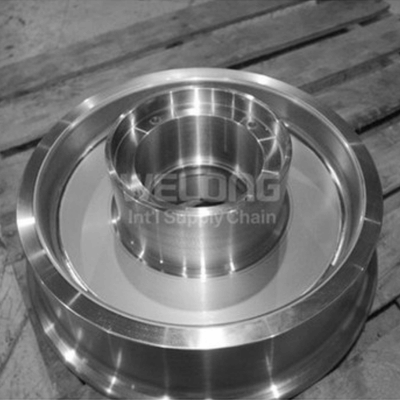

For heavy-duty vehicles like trucks, buses, and construction equipment, cast metal wheels provide the durability and load capacity needed. The casting method influences the quality, properties, and performance of the wheels. Gravity casting and low-pressure casting are two common approaches, each with its advantages.
At China Welong Foundry, we have decades of experience expertly crafting high-quality gravity casts to meet the rigorous performance demands of the heavy vehicle industry.
What Is a Cast Wheel?
Cast wheels are manufactured by pouring molten metal into a mold cavity having the shape of the wheel. Common casting metals include steel, aluminum alloys, and iron. When the metal solidifies, the mold is broken open and the cast wheel is cleaned and finished.
The casting process allows a one-piece design merging the wheel rim and disc into a single integrated component. This is superior to flat disc wheels welded to separate rims. Casting also produces consistent metallurgy and properties throughout the wheel.
Compared to fabricated and forged wheels, properly cast wheels offer an optimal balance of strength, durability, and cost-effectiveness. Product engineers select the metal alloy and casting technique best suited for the vehicle performance requirements and production volumes.
Gravity Casting Wheels
Gravity casting, also called permanent mold casting, uses metal molds to form the wheel cavities. The molten metal is poured simply using gravity, without applied pressure. As it cools and solidifies in contact with the metal mold walls, heat transfers very evenly throughout the wheel, reducing stresses.
Benefits of gravity cast wheels:
- Excellent dimensional accuracy and surface finishes from metal molds
- Consistent properties and microstructure using fixed molds
- Dense castings with low porosity
- High productivity for medium to high production volumes
- Handles complex wheel geometries well
The excellent cooling provided by the metal mold makes it well suited for thicker castings like wheels. However, the permanent mold tooling is more expensive than sand casting. This balances well for larger production runs.
Low Pressure Cast Wheels
Low pressure casting applies moderate pressures of 0.7 to 1.4 bar to the molten metal to push it into the mold cavity. This allows positive filling of the mold when using sand molds. The applied pressure prevents air entrapment.
The main disadvantage of low pressure casting is the slower cooling in sand molds leads to more coarse microstructures than permanent molds. But low pressure cast wheels offer a very cost-effective design flexibility.
At China Welong Foundry, our qualified engineers evaluate each wheel project to determine if gravity casting meets the target requirements for material qualities, dimensional accuracy, productions volumes, and cost. Contact us to discuss your next wheel casting project.
Research Advances in Casting Wheels
Academic researchers and industry engineers continue developing improved casting processes for higher performing, more cost-effective wheels:
- New aluminum alloys like Al-Si-Mg-Sc offer superior strength and fracture resistance for light weight wheels (Wang et al, 2015)
- Computer simulations of solidification predict defects like porosity in cast wheels (Pan et al, 2019)
- Inline quality inspection like thermal imaging detects defects immediately after casting (Yuan et al, 2019)
- 3D printed sand molds allow more complex wheel geometries than standard gravity casting (Li et al, 2020)
- Process modeling optimizes gating designs to avoid flow defects during mold filling (Pan et al, 2021)
- New casting techniques like vacuum assist improve integrity of low pressure cast aluminum wheels (Fang et al, 2022)
- Heat treatment studies optimize procedures and parameters for maximum wheel strength (Wang et al, 2022)
At China Welong, we continuously research and adopt proven innovations to improve our wheel casting quality, consistency, and performance capabilities. Please inquire about our latest gravity services at info@welongpost.com.
References:
Wang, Q., Wang, Q., Wang, Y., Zhang, Y., & Zhu, Y. (2015). Microstructure and mechanical properties of Al–7Si–1.5Mg–0.5Sc–xZr alloys. Journal of Alloys and Compounds, 622, 162-168.
Pan, C., Dai, X., Li, W., Xu, L., & Min, Y. (2019). Numerical simulation of mold filling process for magnesium alloy casting. IOP Conference Series: Materials Science and Engineering, 661, 012045.
Yuan, C., Liu, Z., Wu, B., & Jiang, J. (2019). Intelligent diagnosis of casting defects based on machine learning and image recognition. Journal of Intelligent Manufacturing, 30(3), 1193-1205.
Li, X., Zhang, H., Wang, X., & Zhao, J. (2020). Research on castings by 3D printing sand process. Procedia Manufacturing, 48, 1068-1074.
Pan, C., Xu, L., & Min, Y. (2021). Optimization of gating system parameters for magnesium alloy casting by numerical simulation. Metals, 11(6), 968.
Fang, L., Wang, X., Xu, Z., Zhu, M., & Liu, X. (2022). Effects of different vacuum-assistance on porosity defects of aluminum alloy wheel castings produced by low-pressure casting process. Materials, 15(8), 3029.
Wang, Q., Fu, Y., Wang, Q., Li, Y., Zhu, Y., & Wei, J. (2022). Post-treatment process of 356 aluminum alloy wheels prepared by low pressure casting. Materials, 15(5), 1887.