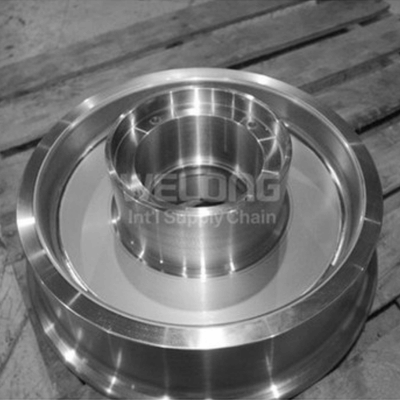

Warm forging is a die forging process in which the die is heated to the forging temperature of the metal. It makes full use of the plasticity of the metal and reduces the deformation resistance. Forging is possible even with smaller tonnage equipment. Workpieces with complex shapes can be formed. It is mainly used for processing high-temperature alloy forgings such as aluminum alloys and titanium alloys, which are difficult to deform during die forging and have a narrow deformation temperature range. Warm forging is a forging process in which the metal is heated to near the recovery temperature or recrystallization temperature. In warm forging, the work hardening is reduced to various degrees, so the forging deformation force is lower than that of cold forging, but larger than that of hot forging. The precision, surface roughness, surface oxidation, decarbonization degree and mechanical properties of the forged products are better than those of hot forged products and are equivalent to those of cold forged products. It is also possible to forge high carbon steel and high alloy steel materials that are difficult to form by cold forging.
Meaning
Generally, small precision die forgings made of low carbon steel and low alloy steel with less complex shapes can be formed by cold forging. For small and medium-sized precision die forgings made of medium carbon steel with complex shapes, it is difficult to solve the forming problems with cold forging, or the cost of cold forging alone is too high, so warm forging can be used.
Generally, the recrystallization temperature of steel is about 750 ° C. Forging at 700 ° C or higher can dynamically release the deformation energy and greatly reduce the forming resistance. Forging at 700-850 ° C will result in less oxidation scale on the forging, slight surface decarburization, and small size change. Forging at 950 ° C or higher will result in smaller forming force, but the oxidation scale and surface decarburization of the forging will be severe, and the size change will be large. Therefore, forging in the range of 700-850°C will result in higher quality and more accurate forgings.
Warm forging refers to forging steel at a temperature below the crystallization temperature but above room temperature. The purpose of using warm forging technology is to obtain precision forgings. The advantage of warm forging is that it can improve the precision and quality of forgings without applying large forming forces like cold forging. The application of warm forging technology is closely related to the forging material, forging size, and forging complexity.
Features
Warm forging is a plastic forming process developed based on cold forging with little cutting. The deformation temperature is usually in the range of above room temperature and below the recrystallization temperature. The general warm forging temperature range for ferrous metals is generally 200°C to 850°C, and for non-ferrous metals, it is generally above room temperature and below 350°C.

Figure 1 Technical and economic comparison of warm forging, cold forging, and hot forging
Warm forging combines the advantages of cold forging and hot forging to some extent. Warm forging heats the metal, so the deformation force of the blank is smaller than that of cold forging, and forming is easier than cold forging. It can use a larger deformation amount than cold forging, so the number of processes is reduced, the die cost and equipment tonnage are reduced, and the die life is also longer than cold forging. Compared with hot forging, the heating temperature is lower, so there is less oxidation and decarburization, and the dimensional tolerance grade of the forged product is higher and the surface roughness is lower.
The technical and economic comparison of warm forging, cold forging, and hot forging is shown in Figure 1 on the right.
Warm forging is mainly used for materials that have poor plasticity and are prone to cracking when cold deformed, such as stainless steel, alloy steel, bearing steel, tool steel, aluminum alloy, copper alloy, etc., which are severely hardened or have a large deformation force when cold forging, materials that are difficult to cold work but will oxidize significantly at high temperatures and absorb air, such as titanium, molybdenum, chromium, etc., materials that are complex in shape or are not suitable for cold forging to improve the comprehensive mechanical properties of the product, when the degree of deformation is large, the part size is large, and the capacity of the cold forging equipment is insufficient.