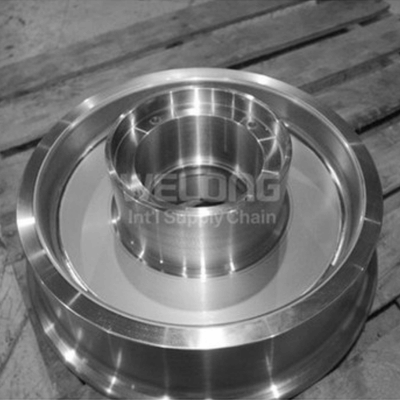

Sand ingress in lost foam is a common defect in lost foam casting. The sand ingress location may involve the sprue/cross runner/ingate, etc., especially the part where the pouring system is gradually combined.
Slag inclusion defect in lost foam casting
Slag inclusion defect refers to the defect formed when dry sand particles, coatings and other inclusions enter the casting with molten iron during the pouring process. On the surface of the machined casting, white or black-gray inclusion spots can be seen, distributed individually or in pieces. The white ones are quartz sand particles, and the black-gray ones are slag, coatings, residues after pyrolysis of foam models and other inclusions. This defect is commonly known as "sand ingress" or "slag inclusion". This defect is a very common defect in lost foam casting production. It is common in almost all factories that use lost foam casting, and it is difficult to completely eradicate it. Only by taking multiple measures and careful operation in each process can the "slag inclusion" be reduced to a very low level and a relatively satisfactory effect be achieved.
Picture
After the lost foam casting is cooled and boxed but before cleaning, the surface condition of the casting and the pouring system can be used to determine whether there are sand inclusion and slag inclusion defects. If the surface or joint of the pouring cup, sprue, runner, ingode and gate and the surface of the casting are seriously sticky or there is crack-like sand, it is basically certain that the casting has slag inclusion and sand inclusion defects. Break the pouring rod or pouring rod, and white spots can be seen on the fracture. In severe cases, a circle of white spots will form on the fracture. Such castings, especially plate-shaped and round pancake-shaped castings, will have white, black and gray spot defects on the machining surface after machining. If the process operation procedures are not strictly controlled, the castings produced will seriously affect the quality of the castings and the progress of order completion.
Causes of slag inclusion and sand inclusion defects
After long-term observation in our production practice, it has been proved that all parts from the pouring cup, sprue, runner, ingode to the casting may cause sand inclusion, especially the joint between the pouring system and the casting. In the whole production process, the paint peeling and cracking on the surface of the white mold of the pouring system, the paint peeling and cracking on the joint of the white mold, the paint peeling and cracking on the surface of the foam plastic white mold, and the loose closure of the sprue are the main reasons for the defects of slag inclusion and sand ingress. Secondly, the selection of process parameters, such as the net pressure head size of the pouring system, the pouring temperature, the negative pressure size, the dry sand particle size, and the model transportation process and packaging operation, have a great influence on the defects of slag inclusion and sand ingress in the casting. Only by taking systematic measures and careful operation in these links can the slag inclusion defects of the castings be reduced and basically eliminated to obtain high-quality castings. Overcoming the slag inclusion defect is a systematic project.
Methods and measures to reduce and overcome the slag inclusion defect
Sand ingress and slag inclusion defects are a major problem in the production of lost foam casting. At present, the three types of products that are successfully produced in lost foam casting are mainly wear-resistant parts, pipe fittings and box castings, which are castings that are rarely or not processed. For castings with many processing surfaces and high requirements, slag inclusion defects are a key problem that needs to be solved. Our experience is that measures can be taken from the following aspects to reduce and eliminate slag inclusion defects:
1. Coating
The role of lost foam coating is: 1) to improve the surface finish of castings, reduce the roughness of castings by 2-3 levels, and improve the surface quality and performance of castings. 2) Reduce and prevent sand sticking and sand hole defects. 3) It is conducive to sand cleaning and sand falling. 4) During pouring, the molten liquid and gas of the lost foam are discharged smoothly through the coating layer into the casting sand, and the metal liquid is prevented from penetrating into the sand mold, and the casting is prevented from producing pores, metal penetration and carbon defects. 5) Improve the strength and rigidity of the mold, prevent deformation and damage during transportation, sand filling and vibration molding, and help improve the dimensional accuracy and yield of castings. The coating for lost foam casting is required to have a series of properties such as strength, air permeability, refractoriness, insulation, explosion crack resistance, rapid cooling and heating resistance, hygroscopicity, cleaning, coating, suspension, and non-flowing. To prevent slag inclusion defects, the coating must first have high strength and refractoriness. The coating layer applied to the surface of the white mold is required not to crack or split during drying and transportation, that is, the coating should have sufficient room temperature strength; and during the pouring process, the coating layer should not fall off or crack or split under the long-term scouring of high-temperature metal, that is, it should have high high-temperature strength. When the liquid metal enters the mold, the sprue is tightly closed, and the coating layer on the surface of the casting and the pouring system does not fall off, crack or split. This is the primary condition for preventing slag inclusion defects. If the runner is not tightly sealed, the coating layer will fall off, crack or split, and a large amount of sand, coating and inclusions will enter the metal to form slag inclusion defects. Strength and air permeability are two important properties of coatings. Sometimes the coating used in the pouring system is required to have higher fire resistance than the casting coating to withstand the long-term scouring of high-temperature metal without falling off or cracking. The operator must ensure the uniformity of the coating during the painting process.
2. Packing operation
During packing, the coating layer on the surface of the pattern group (model + pouring system) is not allowed to fall off, crack or crack, especially at the joints of the sprue and the runner, the runner and the ingode, and the ingode and the mold. Sand may enter as long as there is looseness, cracks or unreliable connection. This requires that the joint strength should be high, the coating should be relatively thick, the pouring system should have sufficient rigidity, and tie bars or reinforcement sleeves should be set when necessary. The pattern group should be placed on the bottom sand of the sand box steadily. It is not allowed to start sanding and vibrating the model when it is suspended in the air to avoid cracking the coating layer. Do not add sand violently to the pattern. Use a hose to add sand first, and then use a rain sprinkler to sprinkle sand when vibrating. When starting to vibrate the model, the vibration should be slight and the amplitude should be small. Wait until the dry sand buries the model before vibrating it sharply. When vibrating the model, the pouring system, especially the sprue, is not allowed to be bent or bent to avoid cracking the coating layer. The sprue should be tightly closed to prevent sand from entering. The entire process of packing, sanding, vibration and molding should be very careful and cautious. It is necessary to ensure that there is no shedding, cracking and cracking of the coating layer of the pattern group before pouring. Before pouring, the pouring cup should be cleaned again to ensure that there is no floating sand, dust and debris.
3. Pouring pressure head, temperature and time
The higher the pressure head during pouring, the greater the scouring of the pouring system and the mold, and the greater the possibility of damaging the coating and causing sand to enter. The pressure head should be different for castings of different sizes. To choose a ladle with appropriate capacity, the ladle should reduce the pouring height as much as possible, and the ladle mouth should be as close to the pouring cup as possible. Avoid using a large ladle to pour small work. The higher the pouring temperature, the higher the performance requirements for the coating, and the more likely it is to produce defects such as sticking sand and slag inclusions. The appropriate pouring temperature should be selected. For gray iron castings, the furnace temperature can be around 1480℃, and the pouring temperature is 1380-1420℃; the furnace temperature of ductile iron castings should be above 1500℃, and the pouring temperature is 1420-1450℃; the pouring temperature of steel castings is 1480-1560℃. The pouring time of a box of cast iron parts that requires 300-500 kg of molten iron can be controlled at around 10-20 seconds.
4. Negative pressure
The pouring process of lost foam casting is generally carried out under vacuum conditions. The role of negative pressure is to compact dry sand, accelerate exhaust, and improve filling capacity. Pouring under vacuum sealing conditions improves the working environment. The size of negative pressure has a great influence on the quality of castings. Excessive negative pressure increases the possibility of molten metal inhaling dry sand and inclusions when flowing through cracks and cracks, and also increases the sand sticking defects of castings. Too fast filling speed increases the metal's ability to flush the runner and mold, which can easily cause the paint to fall off and enter the metal, and it can also easily damage the paint layer and cause sand to enter. For cast iron parts, the appropriate negative pressure is generally 0.025-0.04MPa.
5. Setting slag blocking, slag skimming and slag collecting risers
Setting slag blocking, slag skimming in the pouring system and setting slag collecting risers on the castings and taking slag blocking and slag skimming measures can help improve sand entry and slag inclusion defects.
6. Molding sand Molding sand with too coarse or too fine grains will affect the generation of slag inclusion and sand sticking defects. Too coarse grains will increase sand sticking and slag inclusion defects. Cast iron parts generally use dry quartz sand (washed sand) with a particle size of 30/50.
7. Use molten iron purification technology The entire molding process of lost foam castings must consider the problem of molten iron purification, which is one of the key technologies of lost foam casting. Purification issues must be considered throughout the entire process, from molten iron smelting, overheating, to pouring into molds, and filtration technology is one of them.