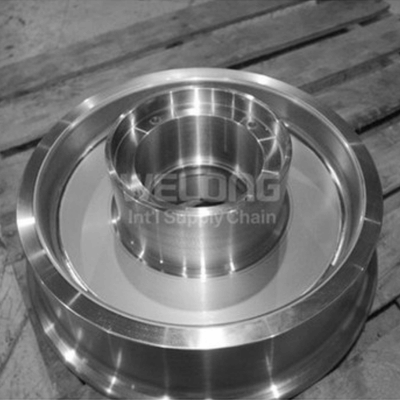


Aluminum alloy products are divided into cast aluminum products and aluminum profiles. The main difference between them lies in the fact that one is manufactured using casting molds, while the other is produced using extrusion dies. In both cases, aluminum alloys (usually aluminum–magnesium–silicon alloys) are used as raw materials.
Aluminum profiles: Common examples of aluminum profiles include screens and aluminum windows. They are manufactured by the extrusion forming process, in which raw materials such as aluminum billets are melted in a furnace and then extruded through an extruder to obtain the desired shape. Various profiles with different cross-sectional shapes can also be extruded. The main properties, namely strength, hardness, and wear resistance, comply with the national standard GB6063. The advantages include: light weight (only 2.8 kg), corrosion resistance, rapid design changes, low mold manufacturing costs, and longitudinal lengths of up to 10 meters or more. Aluminum profiles are available with glossy and matte surfaces, and the surface treatment process includes anodizing, which can achieve an oxide film thickness of 0.12 mm. The wall thickness of aluminum profiles is selected based on product structural optimization; in the market, greater thickness does not always mean better quality. During design, cross-sectional requirements should be considered, and the thickness may range from 0.5 mm to 5 mm.
Advantages
Less machining: Since aluminum alloys can be extruded into any complex shape, extruded aluminum profiles are easy to assemble, reducing the need for machining when the design is appropriate. Some shapes can only be achieved by extrusion rather than other processes.
Low cost of aluminum extrusion dies: Aluminum extrusion dies are less expensive compared with dies for other competing materials and processes such as rolling, casting, and forging.
High structural efficiency: Extruded aluminum profiles provide maximum structural efficiency. Material can be used where strength is required and eliminated where it is not needed.
Light weight: Extruded aluminum alloy profiles are lightweight yet strong and durable. Due to differences in material properties, aluminum structures that achieve the same performance weigh approximately half as much as other metal structures, which are also more difficult to process.
Various surface treatment options / High corrosion resistance: By using powder coating or electrophoretic coating, designers can achieve any desired color. Natural silver finishes or colored anodized coatings are also available.
Low maintenance cost: Aluminum is a durable metal, and the above surface treatment processes further enhance its service life.
Disadvantages
Non-uniform structure and properties: Due to uneven metal flow during extrusion (especially in direct extrusion without lubrication), the microstructure of extruded products is non-uniform between the surface and the center, as well as between the head and tail sections.
Harsh working conditions for extrusion dies: During extrusion, the billet is in a nearly closed state with high pressure on the die, requiring the die to withstand extremely high loads. At the same time, during hot extrusion, the die is subjected to high temperatures and friction, which significantly affect its strength and service life.
Low production efficiency: Except for continuous extrusion, which has been developed in recent years, traditional extrusion methods cannot achieve continuous production. Generally, extrusion speed is much lower than rolling speed, resulting in significant geometric losses and low yield rates.
Die casting: Die casting is a manufacturing process in which molten metal is forced into a mold under pressure, and after cooling, a metal product is formed. This process is similar to pressure casting. The materials used for die casting are molten metals, so the molds are made of high-strength alloy steel. Die casting materials are generally non-ferrous, such as zinc, copper, aluminum, lead, and their alloys, since these materials have relatively low melting points.
Die casting is divided into two types: cold chamber die casting and hot chamber die casting. In cold chamber die casting, molten metal is poured manually or automatically into the pressure chamber, and then pressure forces the molten metal into the mold. In hot chamber die casting, the molten metal is continuously heated and maintained in a liquid state. When pressure is applied, the molten metal is injected into the mold cavity. After solidification, the die opens, the casting is ejected, and the die-cast part is completed.
High pressure and high speed are the two main characteristics of the die casting process and the most fundamental differences between die casting and other casting methods. Since high pressure and high speed are used to force the molten metal into the mold cavity in a very short time, high flow velocity and short filling time are required. Die casting is suitable for producing complex and high-precision parts and products, such as consumer goods (e.g., faucets and radiators). It is also widely used in the automotive, electrical, aerospace, and medical industries.
Compared with profile forming methods, die casting uses different technologies. Aluminum ingots (approximately 92% purity) and alloys are used as raw materials, which are melted in a furnace and then formed in a die casting machine. Cast aluminum products can have various shapes, such as toys, which facilitates multi-directional assembly. In addition, they have high hardness and strength and can be alloyed with zinc to form zinc–aluminum alloys. The aluminum die casting forming process includes:
① Die casting
② Rough polishing to remove residues from the mold
③ Fine polishing
Advantages
Since aluminum die casting uses a pressure casting process, die-cast aluminum parts have accurate dimensions and smooth surfaces; they are generally used directly without additional machining or with minimal machining. This not only improves metal utilization efficiency but also significantly reduces the amount of process equipment and labor.
Die-cast aluminum products are inexpensive; they can be combined with other metals or non-metals, saving assembly time and materials.
Aluminum die casting features high production efficiency. For example, a domestic JIII3 horizontal cold-chamber aluminum die casting machine can produce an average of 600–700 aluminum castings every 8 hours, while a small hot-chamber aluminum die casting machine can produce an average of 3,000–7,000 castings every 8 hours. Aluminum die casting molds have a long service life. A pair of molds for aluminum and bell-shaped aluminum alloy castings can last hundreds of thousands or even millions of cycles. They are easy to mechanize and automate.
Die-cast aluminum products are of high quality and high dimensional accuracy, generally equivalent to Grade 6–7, and sometimes reaching Grade 4. The surface quality of die-cast aluminum is good, generally equivalent to Grade 5–8. Strength and hardness are usually 25–30% higher than those of sand castings, but elongation is reduced by approximately 70%. Dimensions are stable, interchangeability is good, and thin-walled and complex aluminum castings can be produced.
Disadvantages
Low toughness and poor wear resistance; significant volumetric shrinkage during solidification, approximately 6.6%; high coefficient of linear expansion; tendency to stick to molds, requiring strict control of iron content within 0.8%–0.9%; low melting point, limiting its use in high-temperature applications.