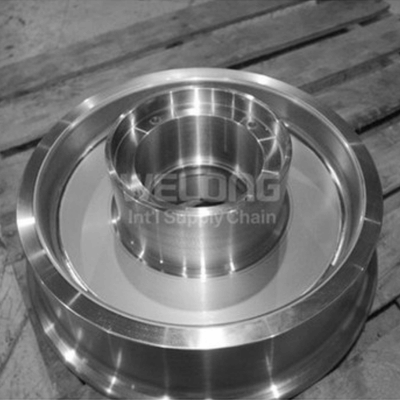

Quenching is a heat treatment process designed to strengthen steel parts by rapid cooling. Quenching of steel is a heat treatment process in which the steel is heated to a critical temperature of Ac3 (sub-eutectic steel) or Ac1 (per-eutectic steel) or higher, held for a period of time to austenitise all or part of the steel, and then cooled faster than the critical cooling rate to below Ms (or isothermal near Ms) to carry out the martensitic (or bainitic) transformation.
Process: heating, holding, cooling.
- Heating: the steel is heated to the critical temperature Ac3 (sub-eutectic steel) or Ac1 (over-eutectic steel) above.
- Holding time: keep a certain time, so that all or part of the steel austenitising.
- Cooling: fast cooling to below Ms at a cooling rate greater than the critical cooling rate for martensitic or bainitic transformation.
The essence of Quenching: is to supercooled austenite for martensite or bainite transformation, to obtain martensite or bainite organisation.
The purpose of Quenching:
(1) To substantially improve the rigidity, hardness, wear resistance, fatigue strength and toughness of steel, so as to meet the different requirements for the use of various mechanical parts and tools;
(2) through Quenching to meet some special steel ferromagnetism, corrosion resistance and other special physical and chemical properties.
Quenching steel parts have the following characteristics:
- Unbalanced organisation such as martensite, bainite and residual austenite are obtained.
- The existence of large internal stress.
- Mechanical properties can not meet the requirements. Therefore, the steel after Quenching generally have to go through tempering treatment.
Scope of application: Quenching process is most widely used, such as tools, gauges, moulds, bearings, springs and automobiles, tractors, diesel engines, cutting machine tools, pneumatic tools, drilling machinery, agricultural implements, petroleum machinery, chemical machinery, textile machinery, aircraft and other parts are using the quenching process.
Quenching Media
Workpiece Quenching cooling medium used is called quenching cooling medium (or quenching medium). Ideal quenching medium should have the condition that the workpiece can be quenched into martensite, but does not cause too much quenching stress.
Commonly used Quenching medium are water, aqueous solution, mineral oil, molten salt, molten alkali and so on.
Water
Water is a strong cooling capacity of the Quenching medium.
Advantages: wide source, low price, stable composition is not easy to deteriorate.
Disadvantages: cooling capacity is not stable, easy to make the workpiece deformation or cracking. In the C curve of the 'nose' area (500 ~ 600 ℃ or so), water in the vapour film stage, cooling is not fast enough, will form a 'soft spot'; and in the martensite transformation temperature zone (100 ~ 300 ℃), water is in the boiling stage, the cooling is too fast, easy to make the Martensite transformation rate is too fast and produce a lot of internal stress, resulting in workpiece deformation or even cracking. When the water temperature rises, the water contains more gas or water mixed with insoluble impurities (such as oil, soap, mud, etc.), will significantly reduce its cooling capacity.
Application: It is suitable for quenching and cooling of carbon steel workpieces with small cross-section size and simple shape.
Salt water and alkaline water
Add an appropriate amount of salt and alkali in water, so that high-temperature workpiece immersed in the cooling medium, in the steam film stage precipitation of salt and alkali crystals and immediately burst, the steam film is destroyed, the surface of the workpiece oxidation skin is also blown up, so that you can improve the medium in the high-temperature zone of the cooling capacity, the disadvantage is that the medium of the corrosive nature of the large.
Application: In general, the concentration of brine is 10 per cent, and the concentration of aqueous caustic soda solution is 10 to 15 per cent. Can be used as a quenching medium for carbon steel and low alloy structural steel workpieces, the use of temperature should not exceed 60 ℃, quenching should be cleaned in time after the quenching and anti-rust treatment.
Oil
Cooling medium generally use mineral oil (mineral oil), such as motor oil, transformer oil and diesel fuel. Motor oil is generally used 10, 20, 30 motor oil, the larger the number of oil, the greater the viscosity, the higher the flash point, the lower the cooling capacity, the use of temperature increases accordingly.
Quenching method
Single-liquid Quenching
Quenching is a quenching operation in which austenitic parts are immersed in a quenching medium and cooled to room temperature. Single-liquid Quenching media include water, brine, alkaline water, oil and specially formulated quenching agents.
Quenching martensitic graded quenching
Is the austenitic chemical parts first immersed in the temperature slightly higher or slightly lower than the martensite point of steel in the liquid medium (salt bath or alkaline bath), to maintain the appropriate time, to be the steel parts of the inner and outer layers of the medium have reached the temperature of the air-cooled, in order to obtain the martensite organisation of the quenching process, also known as the quenching of the graded quenching.
Bainite isothermal Quenching
Quenching is the austenitising of steel parts, so that the fast cooling to the bainite transformation temperature range (260 ~ 400 ℃) isothermal holding, so that the austenite transformation to bainite quenching process, sometimes also called isothermal quenching, general holding time of 30 ~ 60min.
Composite Quenching
The workpiece is cooled sharply to below Ms to obtain 10% to 20% martensite, and then isothermal in the lower bainite temperature zone. This cooling method can make the larger section of the workpiece to obtain M + B organisation. The martensite formed during pre-quenching promotes the bainite transformation, and the martensite is tempered during isothermal tempering. Composite quenching is used for alloy tool steel workpieces to avoid Type I temper brittleness and to reduce the amount of residual austenite, i.e. the tendency to deformation cracking.