


The camshaft silently regulates when an engine breathes in and when it breathes out, opening and shutting valves thousands of times a minute. How it is built is important, since it functions under continual strain, friction, and vibration. A forged camshaft is made by heating a steel billet and then applying extreme pressure, which refines the internal structure of the metal and gives it excellent toughness. The main issue for engine builders, fleet owners, and equipment makers is whether that greater strength translates into actual advantages in longevity and performance. This page covers the science of forging, materials and heat treatment, the need for accuracy, and the kind of designs that lend themselves to demanding engines.
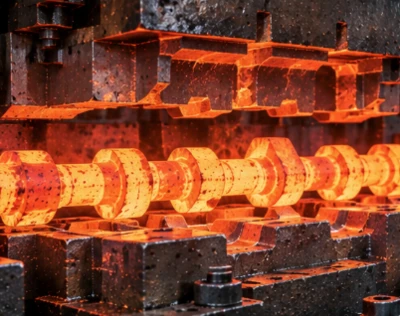
How Does Forging Improve Camshaft Strength and Fatigue Resistance?
Grain Flow That Follows the Shape
During the forging of steel, the grain structure is crushed and aligned to the curves of the part. This constant flow of grain goes through the lobes and journals of a forged camshaft rather than being cut through, as in the case of machined-from-bar components. The net effect is a very tough part where the stress is highest and hence better able to withstand breaking in long-term use.
Dense Structure With Fewer Internal Voids
Casting may leave little holes or shrinkage pockets, whereas forging compacts the metal into a homogeneous mass. The thick internal structure results in consistent mechanical properties from part to part for forged camshafts. That stability is handy for engines that run a lot of hours, since predictable behavior makes it much simpler to schedule maintenance and to get warranty coverage.
Better Fatigue Life Under Repeated Loading
Each rotation subjects the lobes and the body of the shaft to cyclic stress. So, fatigue resistance is one of the most significant features of a camshaft. The refined grain structure and high core toughness of a forged camshaft allow it to handle repeated loads effectively, enabling engines to keep valve timing accurate during harsh duty cycles and long service intervals.
Forged Camshaft Material, Heat Treatment, and Wear Resistance
Choosing the Right Steel Grade
The basis is the choice of material. Alloy steels like 4140, 4340, and 5150, and carburizing grades are popular alternatives because they provide strength with high machinability. A camshaft produced from a good choice of alloy may be tailored for high-load applications, whether you want toughness, surface hardness, or a compromise between the two.
Heat Treatment for a Hard Surface and Tough Core
Lobes are in sliding contact with lifters or followers; therefore, surface hardness is important. Induction hardening, carburizing, and nitriding are processes that provide a hard exterior layer and a tough core. For a forged camshaft, this coupling means the surface resists wear, the body absorbs stress, supporting long, quiet, reliable operation.
Surface Finishing and Wear Protection
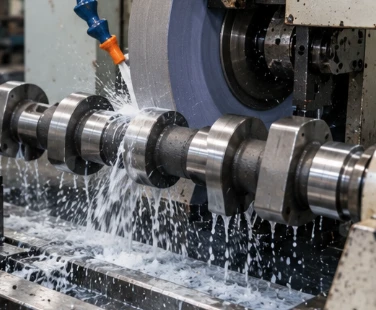
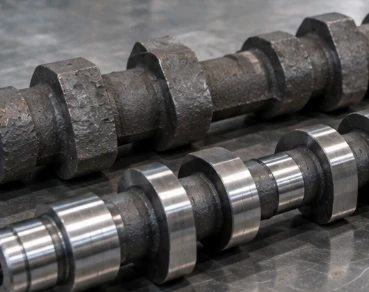
Heat treatment is followed by grinding and polishing to achieve the lobes' exact contours and smooth finishes. Some designs of forged camshafts additionally include phosphate coatings or other treatments to aid with break-in and lubrication. A smoother surface will minimize friction, hold oil film better, and allow the mating parts to wear uniformly, increasing the operational life of the whole valve train.
What Role Does Camshaft Precision Play in Engine Performance?
Accurate Lobe Profiles Control Valve Timing
The shape of the lobe dictates how far and for how long each valve is lifted. Even the smallest of differences may alter airflow, combustion quality, and power output. A forged camshaft machined to precise tolerances guarantees the valve events are true to the engine designer's intent, resulting in smoother idle, greater response, and more consistent performance over the operating range.
Concentricity, Straightness, and Smooth Rotation
Journals must be concentric, and the shaft straight, so that it spins without wobbling. Poor geometry causes more vibration and bearing wear. The forged camshaft manufacturer will use precise grinding and inspection equipment to keep the runout modest. This contributes to quiet running, consistent oil pressure, and extended bearing life in both passenger car and industrial engines.
Quality Inspection and Repeatability
Precision is meaningless unless it is reproducible. Coordinate measurement equipment, hardness testers, and surface roughness gages verify that each forged camshaft satisfies the drawing. Good inspection records also assist purchasers in tracking batches and maintaining consistent quality throughout big production runs, which is critical for OEM programs and long-term supply contracts.
Forged Camshaft Design for High-RPM and Heavy-Duty Engines
Built for High-RPM Stability
The strains on the valve train increase fast with engine speed. The forged camshaft is robust and torsionally rigid, keeping valve action precise at high RPM when timing drift may be a problem. This stability is a plus for performance engines, racing builds, and modified street engines, especially when used in conjunction with premium lifters, springs, and pushrods.
Strength for Heavy-Duty and Industrial Use
Trucks, generators, marine engines, and construction machinery are working long hours under severe load. Here, a forged camshaft delivers the longevity required to keep engines running through tough schedules. Specifying larger journals, stronger cores, and carefully chosen steels may match the torque and duty cycle of each application.
Custom Designs From Drawings or Samples
Each engine platform is unique, and off-the-shelf parts don't always fit. Specifically, camshafts may be manufactured from client designs or samples with specifically designed lobe profiles, journal diameters, and heat treatment parameters. Your supplier's expertise may help you transition from idea to verified part more easily, while reducing cost and lead time.
Conclusion
A forged camshaft provides a great mix of strength, fatigue resistance, and wear prevention with the proper steel and heat treatment. That strength is then precision-ground and inspected for smooth, precise valve control that helps provide longevity and reliable performance. Whether building a high-RPM or heavy-duty engine, forging is a good choice. Find a good manufacturer now and pick the standard that matches your engine.
FAQ
1. Why choose a forged camshaft over a cast one?
Forging refines grain flow and density, improving toughness and fatigue resistance.
2. Which steels are commonly used?
Alloy steels such as 4140, 4340, and 5150 are widely used.
3. How is the lobe surface hardened?
Induction hardening, carburizing, or nitriding creates a wear-resistant surface layer.
4. Is a forged camshaft suitable for heavy-duty engines?
Yes, its strength suits trucks, generators, marine, and industrial engines.
5. Can a forged camshaft be customized?
Yes, it can be made from drawings or samples with tailored profiles.
Source Your Forged Camshaft From China Welong
Founded in 2001, China Welong is an international supply chain partner for customized metal products, offering supplier development, purchasing supervision, and quality control under ISO 9001:2015. We produce from your drawings or samples, and our engineers can design drawings using AutoCAD, Pro-Engineering, and SolidWorks. Our products have reached automotive and industrial customers across Europe, North America, and Asia-Pacific. If you need a reliable forged camshaft, email your requirements to metal@welongpost.com, and our team will reply promptly with clear advice and a competitive quotation.
References
1. Heisler MW. Heat Treatment of Steel and Ferrous Alloys. ASM International; 2013.
2. ASM International. ASM Handbook, Volume 14A: Metalworking: Bulk Forming. ASM International; 2005.
3. Heywood JB. Internal Combustion Engine Fundamentals. McGraw-Hill; 1988.
4. Stone R. Introduction to Internal Combustion Engines. Palgrave Macmillan; 2012.
5. Dowson D. History of Tribology. Professional Engineering Publishing; 1998.
6. Dieter GE. Mechanical Metallurgy. McGraw-Hill; 1986.


