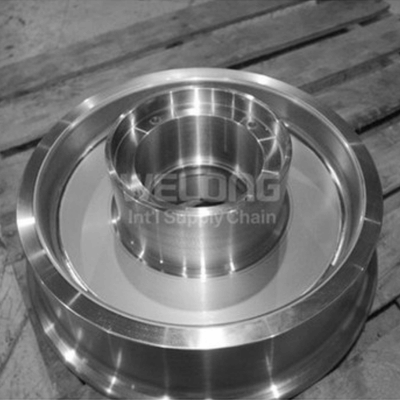

Ⅰ. What is Forged hub?
A forged hub is a critical component in machinery and vehicles that provides a mounting point for wheels or other rotating parts. it is made by pressing or hammering a metal blank into a die at high temperatures to form the desired shape. The forging process aligns the metal's grain structure and produces a very strong, dense part that is ideal for high-stress applications.
Compared to cast or machined hubs, it offers superior strength and durability. The forging process creates a seamless, continuous grain flow that improves the hub's ability to withstand fatigue and shock loading. This makes it well-suited for performance vehicles and heavy machinery where reliability is paramount.
Ⅱ. Types
There are several common types of forged hubs used in various industries:
① Wheel Hubs
Wheel hubs are mounted to axles and provide an attachment point for wheels on cars, trucks, and other vehicles. High-performance autos often use lightweight forged aluminum wheel hubs. Heavy-duty trucks and construction equipment rely on forged steel hubs to handle extreme loads.
② Gear Hubs
These hubs have integrated gear teeth and are found in differentials, transmissions, and power transmission systems. The forging process allows complex gear geometries to be formed in strong steel or aluminum.
③Flange Hubs
Flange hubs feature a protruding rim and bolt pattern to facilitate connections to shafts, wheels, or other components. Various industries use customized flange hubs for power transmission applications.
④ Hub Assemblies
Hub assemblies consist of a hub with added components like bearings, seals, and brake rotors. Forged hubs provide a robust foundation for these critical assemblies.
Ⅲ. Materials used in the forging process
① Steel - Widely used for its strength and durability. Common alloys include 4140, 4340, and 8620. Aircraft quality 9310 steel is also used for critical aerospace applications.
②Aluminum - Prized for its light weight and corrosion resistance. Popular alloys include 6000 series, 2000 series, and 7000 series. Aluminum hubs enhance performance in race cars and sports vehicles.
③Titanium - An exotic metal with an exceptional strength-to-weight ratio. Used in costly, high-performance hubs where weight savings are critical. Difficult material to forge and machine.
④Magnesium - The lightest structural metal. Used for extreme weight reduction in racing applications despite flammability concerns. Challenging to forge and susceptible to corrosion.
The chosen material depends on the required mechanical properties, environment, cost considerations, and forging capabilities.
Ⅳ.Advantages and disadvantages compared to other manufacturing methods
Advantages
- Excellent strength-to-weight ratio
- Seamless, continuous grain structure
- Resistance to fatigue and shock loads
- Complex geometries can be forged
- Consistent material properties
- Low scrap rates compared to machining
- Faster production than casting
- Parts consolidation - hubs with integrated mounts or gears
Disadvantages
- High initial dies costs
- Size limitations based on press capacity
- Long lead times for die fabrication
- Significant material deformation requires extreme pressures
- Design changes require new dies
- Restricted to high volume applications
Ⅴ.Specific applications in different industries
Forged hubs are found in diverse industries where performance and durability are vital. Some examples include:
①Automotive - Forged aluminum alloy hubs reduce weight in high-end sports cars and racing vehicles. Mass market vehicles employ forged steel hubs for reliability.
②Aerospace - Aircraft landing gear, turbine engines, and structural parts all utilize forged titanium and nickel alloy hubs.
③ Off-Highway Vehicles - Forged steel hubs withstand extreme shock and vibration in construction equipment, mining trucks, and agricultural machinery.
④ Material Handling - The wheels and gearboxes in conveyor systems, cranes, and heavy-lift transporters rely on forged steel hubs.
⑤ Oil and Gas- Drilling equipment and production facilities are full of forged components including valve housings and pump hubs.
⑥Power Generation - Turbines, generators, gearboxes, and other powerplant equipment often specify forged alloy hubs.
⑦ Rail Transportation - Forged steel wheelset hubs provide durability in freight and passenger locomotives.
⑧ Marine Transportation - Propeller shafts, bow thrusters, and other dynamic marine systems utilize forged stainless steel hubs.
⑨ Defense - Tanks, artillery systems, etc.
In summary, forged hubs play an indispensable role across industries where safety and performance cannot be compromised. Their unique advantages stem from the forging process's ability to create super-strong, fatigue-resistant parts capable of surviving extreme operating environments. With continual innovation in alloys and process engineering, forged hubs will continue improving the reliability of critical machinery. Please contact China Welong at info@welongpost.com to discuss engineering your next solution.
References:
Totten, G.E. (2006). Steel Heat Treatment Handbook (2nd ed.). CRC Press.
Doege, E., & Meyer-Nolkemper, H. (1986). Metalforming practices and processes. Carl Hanser Verlag GmbH Co KG.
Groover, M.P. (1996). Fundamentals of modern manufacturing: materials, processes, and systems. John Wiley & Sons.
Kuhn, H.A., & Medlin, D. (2000). ASM handbook: Mechanical testing and evaluation (Vol. 8). ASM international.
Stephenson, D.A., & Agapiou, J.S. (2006). Metal cutting theory and practice (3rd ed.). CRC Press.