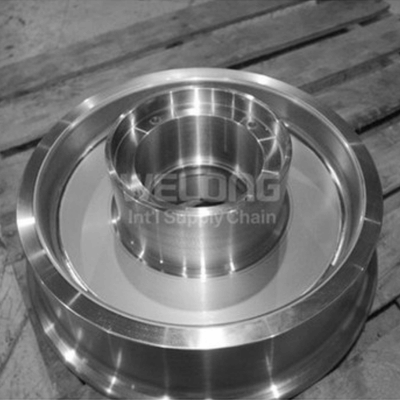

Centrifugal casting, also known as rotocasting, is a versatile metal casting technique used extensively for producing cylindrical and tubular components.
Explaining the Centrifugal Casting Process
It utilizes centrifugal forces generated by spinning molds to impart high radial pressure, driving molten metal towards the mold walls to yield fine-grained castings with excellent mechanical properties (Tschirschwitz et al., 2021).
In horizontal casting, the mold assembly containing the molten metal charge is rotated about its axis within a stationary outer shell. The rotation speed may vary from 300 rpm to over 1000 rpm depending on component size and metallurgy. The metal charge experiences an outward centrifugal force field that forces the liquid towards the inner mold surface, replacing the lower density air (Liu et al., 2018).
As the molten metal solidifies in contact with the relatively cool mold wall, freezing progresses inwards towards the center. The high radial pressure maintains intimate contact with the mold, minimizing shrinkage defects. The fine equiaxed grains induced by rapid solidification coupled with the pressure effect yield castings with superior density, strength and ductility.
It is suitable for axisymmetric components like pipes, tubes, rings, cylinders and sleeves from a wide range of metals based on density, melt viscosity, and solidification characteristics (Tschirschwitz et al., 2021). Light alloys tend to have lower fluidity for effective filling.
Types of Centrifugal Casting Processes
The two main variants include true casting and semi-centrifugal (Tschirschwitz et al., 2021):
1. True casting involves pouring the molten metal charge into a rotating mold. The metal must exhibit adequate fluidity to fill the mold under the centrifugal forces. Light alloys may require pressurized pouring systems.
2. Semi-centrifugal or centrifuging employs initially stationary molds that are filled with metal, followed by accelerating the assembly to spread the charge against the walls before solidification. This allows casting of lower fluidity alloys.
Additionally, there are vertical centrifugal processes wherein the mold rotates about a horizontal axis. The Scheibel process forces metal into top-fed vertically spinning shell molds under gas pressure. Continuous vertical casting allows uninterrupted production.
Overview of Centrifugal Casting Process Steps
Though specific details vary, the general sequence of steps includes (Yang et al., 2020):
1. Mold preparation - Cylindrical or tubular ceramic investment molds are fabricated with the desired inner profile, dimensions and surface finish. The mold assembly includes guidance and support systems.
2. Mounting - The mold assembly is securely attached to a horizontal centrifugal casting machine capable of controlled acceleration and steady rotation.
3. Pouring - At the required rotation speed, the molten metal charge is poured/injected into the spinning mold. Fluid flow simulations can optimize filling.
4. Solidification - As the metal freezes in contact with the mold walls, spinning continues to maintain pressure until the entire casting solidifies. Infrared sensors monitor the process.
5. Cooling and removal - After solidification, the rotation is stopped and the casting is cooled under controlled conditions before demolding and removal.
6. Cutting and post-processing - The cylindrical castings are cut to the required lengths and subjected to finishing steps like heat treatment, straightening, and machining.
It thus harnesses rotational forces for producing high-quality castings unattainable through static casting processes.
Advantages of centrifugal casting process
This process is often used to cast cylindrical parts and components and comes with several advantages:
1. High Material Purity and Quality: Impurities and inclusions, being lighter than the metal, tend to move towards the center of the part, which can be machined away, resulting in a casting with fewer impurities and defects near the surface.
2. Dense and Fine Microstructure: The high pressures lead to a fine-grain microstructure and a dense casting free from gas porosity. This increases the mechanical properties of the final product.
3. Good Mechanical Properties: The combination of the fine-grain structure and dense casting leads to superior mechanical properties such as tensile strength and elongation when compared to similar parts made through other casting processes.
4. Minimal Wastage: The process generates castings that are close to the final shape with a good surface finish, often requiring less machining and finishing, which reduces the material wastage and secondary processing.
5. Versatility: It can accommodate a wide range of metals and sizes, making it versatile for different applications and industries.
6. Efficiency and Economical: For large production runs, it can be an economical choice due to efficiency in material usage, less labor-intensive than some traditional methods, and the possibility of automating the process.
7. Gravity Independent: Since it doesn't rely on gravity, the process can create a more uniform thickness and structure despite complex shapes.
8. Internal Soundness: The centrifugal force compacts the metal and pushes impurities to the bore that can be machined away, which results in a sound and a solid metal component.
9. Control over Metallurgy: The centrifugal force helps in achieving directional solidification, which allows for better control over the metallurgical properties.
The centrifugal casting process, while advantageous for certain applications, may not be suitable for all types of castings or materials. It is most effective for parts with a symmetrical shape around an axis but can be adapted for producing parts without rotational symmetry to some extent with the appropriate design expertise and equipment. If you are interested in this service, Please inquire at info@welongpost.com!
References:
Liu, J. et al. (2018). Investigation and prediction of filling ability of ZL101A aluminum alloy in horizontal centrifugal casting process. Advances in Mechanical Engineering, 10(6), 1-9.
Tschirschwitz, F. et al. (2021). Centrifugal casting. In ASM Handbook, Volume 15: Casting (pp. 784-792). ASM International.
Yang, F. et al. (2020). Centrifugal casting process for pipe fittings of nodular cast iron. Metals, 10(2), 246.