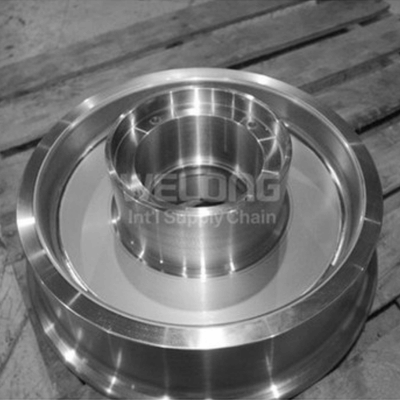

The impeller is an important mechanical component that is widely used in pumps, compressors, turbines, and other equipment in various fields. Its function is to convert energy into hydrodynamic energy and transfer it to the fluid through fluid dynamics to realize the transportation, pressurization, or movement of the fluid that refers to a rotating device with blades, usually used for transporting, compressing, accelerating, or mixing liquids or gases. The impeller can be a structure that is fixed on a shaft and rotates, or it can be a structure that is fixed in the casing and used to push the fluid.

1. Structure and type
It usually consists of several blades, which can be straight, curved, or fan-shaped. According to the arrangement of the blades, it can be divided into three types: centrifugal, axial flow, and mixed flow.
Centrifugal: The blades of them are arranged in a radial pattern. The fluid is forced to turn after entering the impeller and is thrown out by centrifugal force. Centrifugals are widely used in pumps and compressors and are often used to transport clean water, sewage treatment, cooling systems, etc.
Axial flow: The blades of this are arranged in a spiral shape, and the fluid moves almost along the axis when passing through them. Axial flow is mainly used in situations with large air volumes and small heads, such as ventilation systems, cooling towers, ship propellers, etc.
Francis: The Francis combines the characteristics of centrifugal and axial flow. Its blades have both radial and axial components. This kind of this is suitable for medium air volume and medium head applications, such as automobile engine turbochargers, small turbines, etc.
2. Working principle
It converts rotational energy input from a driving source (such as a motor or engine) into fluid energy through rotational motion. When the driving source starts and drives it to rotate, the fluid is sucked into it and gains kinetic energy as the impeller rotates. The shape of it and the angle of the blades determine how the fluid flows over it.
For centrifugal, fluid is sucked in from the center of it, forced to turn with the radial arrangement of the blades, and thrown out under the action of centrifugal force. This process of deflection and ejection causes the fluid to accelerate and increase pressure. For axial flow, the fluid moves almost along the axis of it, and the spiral shape of the blades guides the fluid to its outlet. The mixed flow combines the characteristics of centrifugal and axial flow, allowing the fluid to accelerate and increase pressure because it has both radial and axial components.
3. Functions and applications
The main function of the impeller is to convert the input mechanical energy into kinetic energy or pressure energy of the fluid. Its working principle is based on Newton's third law, which states that the force exerted on each blade will produce an equal and opposite reaction force, thus driving the flow of the fluid.
They are widely used in various fields. The following are some typical application scenarios:
◆Hydropower: In a hydroelectric power station, it is installed on the turbine, and it is rotated by the impact of the water flow, thereby driving the generator to generate electricity.
◆Car engines: Turbochargers in car engines use them to increase air intake and improve engine performance.
Air conditioners and fans: when in air conditioners and fans rotate to create airflow to lower temperatures or provide ventilation.
◆Pump system: The pump system uses one to transport liquid from one location to another. It is common in water pumps, vacuum pumps, and other equipment.

4. Design
The design and manufacture of it require consideration of several factors, including required flow, pressure, speed, and material selection. An excellent design should have the characteristics of high efficiency, stable operation, and reliability.
During the design process, there are several key factors to consider:
◆Blade Shape: The shape of the blades is critical to the performance of it. Blades of different shapes can provide different flow and pressure characteristics.
◆Blade inclination angle: The inclination angle of it blades determines the interaction between the fluid and the blades, affecting the flow direction and speed of the fluid.
◆Material selection: they need to be made of wear-resistant and corrosion-resistant materials to ensure long-term reliable operation.
◆Balance and stability: It needs to be precisely balanced to reduce vibration and noise and ensure stable operation.
In short, as an important mechanical component, the impeller plays a key role in various fields. Through reasonable design and manufacturing, it can efficiently convert energy and transfer fluid to meet different engineering needs.
Contact Us
For more information, please contact us at metal@welongpost.com.