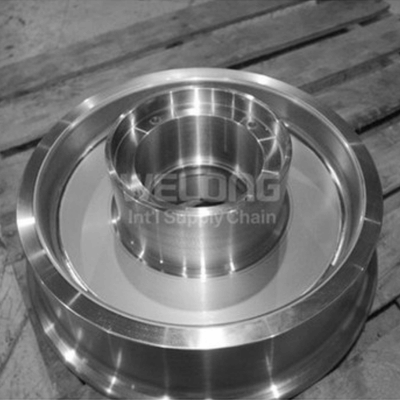


1, Primary processing: from ore to processable billet
This is the most expensive link in the entire titanium industry chain.
Sponge titanium production (mainly Kroll method):
Convert titanium ore (rutile or ilmenite) into sponge titanium (porous pure titanium).
Process: Titanium ore → Chlorination to titanium tetrachloride (TiCl ₄) → Magnesium thermal reduction (Kroll method) → Vacuum distillation → Sponge titanium.
Characteristics: The complex process, huge energy consumption, and intermittent production are one of the fundamental reasons for the high price of titanium alloys. Emerging electrolysis methods, such as the FFC Cambridge process, aim to reduce energy consumption and costs, but have not yet been commercialized on a large scale.
2). Melting:
Melt sponge titanium, alloy elements, and return material into uniformly composed ingots under vacuum or inert gas (argon) protection.
Main technologies:
Vacuum consumable arc melting (VAR): the most mainstream method. The electrode is melted by arc in a vacuum chamber and dropped into a water-cooled copper crucible to solidify. To ensure purity and uniformity, two or three melting processes are usually carried out.
Cold bed furnace melting (CHM): including electron beam cold bed furnace (EBCHM) and plasma arc cold bed furnace (PACHM). It can effectively remove high/low-density impurities and is commonly used in the preparation of high-end aviation grade titanium ingots and titanium billets.
2,Forming manufacturing: shaping the blank into the desired shape
This is the core link that reflects the difficulty of titanium alloy processing.
A. Plastic Forming
Conventional forging: After heating in an air furnace, it is formed using a forging hammer or press. Easy to generate surface oxide layer (alpha embrittlement layer), which needs to be removed later.
Isothermal/hot die forging: a key technology for precision forging of titanium alloys. Heat the mold to a temperature similar to the billet (usually 800-1000 ° C) and form it under slow pressure. This greatly reduces deformation resistance, temperature drop, and surface reaction, enabling the production of near net shape forgings with complex shapes, high precision, and reasonable streamline distribution. However, the cost and energy consumption of molds (commonly made of nickel based superalloys or molybdenum based alloys) are extremely high.
Rolling: Production of plates, strips, bars, and pipes. Hot rolling is carried out in a protective atmosphere or coating to prevent oxidation; Cold rolling requires intermediate annealing to eliminate work hardening.
Squeezing: Used for producing profiles and pipes. After heating the billet, it is extruded through a mold under high pressure. Glass lubricants and protective coatings are required to prevent mold sticking and oxidation.
Superplastic Forming (SPF): By utilizing the superplasticity (extremely high elongation) of titanium alloy at a specific temperature/rate and combining it with air pressure to fit the mold like blowing glass, complex thin-walled components can be formed in one go. Often combined with diffusion bonding (DB) to form SPF/DB technology, used for manufacturing multi-layer hollow structures for aerospace applications.
B. Casting
Vacuum precision casting: mainly carried out in vacuum consumable arc condensing furnaces. The electrode melts in an arc under vacuum and flows into the ceramic mold shell. Due to the reaction between titanium and almost all molding materials, special refractory materials (such as yttrium oxide surface layer) must be used.
Application: Suitable for producing static structural components with extremely complex shapes that do not require extensive machining, such as engine casings, pump bodies, and high-end golf ball heads.
C. Additive Manufacturing (3D Printing) - Revolutionary Technology
Directly using titanium alloy powder or wire material layer by layer to manufacture solid parts is particularly suitable for complex structures, lightweight design, and small batch customization.
Main technologies:
Laser Selective Melting (SLM)/Laser Powder Bed Melting (LPBF): In an inert atmosphere chamber, titanium alloy powder on the powder bed is melted point by point using a fine laser. High precision and good surface quality.
Electron Beam Melting (EBM): Melting powder with an electron beam in a vacuum environment. The forming speed is fast, the thermal stress is low, and the performance of the parts is close to that of forgings, but the surface is relatively rough.
Advantages: The material utilization rate is extremely high (almost 100%), achieving topology optimization structures such as extremely complex lattice, honeycomb, and integrated hollow cooling channels. It is irreplaceable in the fields of aerospace (lightweight scaffolds, blades with cooling channels) and medical (customized porous bone implants).
3, Subsequent processing and handling
1) Machining:
Titanium alloy is a typical difficult to machine material due to its poor thermal conductivity (heat accumulates on the tool), high chemical affinity (easy to react with the tool material), and low elastic modulus (easy to cause tool and vibration).
Countermeasure: Use high rigidity machine tools, specially coated hard alloy or PCD cutting tools, low cutting speed, large feed rate, high-pressure and high flow cutting fluid for sufficient cooling.
Heat treatment:
Annealing: eliminates internal stress, stabilizes structure, and improves plasticity. It is the most commonly used heat treatment.
Solution treatment+aging: used for α+β two-phase titanium alloys (such as Ti-6Al-4V), to obtain dispersion strengthening and improve strength through quenching and low-temperature aging.
Surface Treatment
Cleaning: Sandblasting and acid washing (commonly using HF-HNO ∝ mixed acid) to remove oxide scale and pollution layer.
Strengthening/functionalization: Micro arc oxidation (MAO) generates ceramic coatings to improve wear and corrosion resistance; Nitriding/nitriding improves surface hardness; Anodizing coloring and improving corrosion resistance; Thermal spraying (such as spraying WC Co) improves wear resistance.
Connection technology:
Welding: It needs to be carried out under high-purity argon gas or vacuum protection. Common methods include tungsten inert gas welding (GTAW/TIG), electron beam welding (EBW), and laser welding (LBW). Strict cleaning is required before welding.
Diffusion bonding (DB): Connecting contact surface atoms through mutual diffusion under high temperature and pressure, used for manufacturing SPF/DB components.