


The hardness of metallic materials refers to the material's ability to resist local deformation, particularly plastic deformation, indentation, or scratching. It is an indicator of the material's softness or hardness.
Hardness is divided into three types based on the testing methods.
Scratch Hardness: This is primarily used to compare the hardness of different minerals. The method involves using a rod with one end hard and the other soft, and then dragging the rod across the material being tested. The location where scratches appear determines the hardness of the material. Qualitatively, a harder object leaves a longer scratch, while a softer object leaves a shorter scratch.
Indentation Hardness: This is mainly used for metallic materials. The method involves applying a specific load to press a designated indenter into the material being tested. The hardness of the material is determined by the extent of local plastic deformation on the surface. Due to variations in the indenter, load, and duration of the load, there are several types of indentation hardness tests, including Brinell hardness, Rockwell hardness, Vickers hardness, and microhardness, among others.
Rebound Hardness: This is mainly used for metallic materials. The method involves allowing a specially designed hammer to fall freely from a certain height and impact the sample of the material being tested. The hardness of the material is determined by the amount of strain energy the sample absorbs (and then releases) during the impact, which is measured by the height to which the hammer rebounds.
The most common hardness tests for metallic materials-Brinell hardness, Rockwell hardness, and Vickers hardness-fall under the category of indentation hardness. The hardness value represents the material's ability to resist plastic deformation when another object is pressed into its surface. Rebound hardness tests (Shore, Leeb) measure hardness based on the extent of elastic deformation of the metal, with the hardness value indicating the material's capacity for elastic deformation.
Brinell Hardness
An indenter with a diameter D made of hardened steel or carbide ball is pressed into the surface of the specimen with the corresponding test force F. After the specified holding time, the test force is removed, leaving an indentation with a diameter d. The Brinell hardness value is calculated by dividing the test force by the surface area of the indentation. The resulting value is the Brinell hardness, denoted as HBS or HBW.
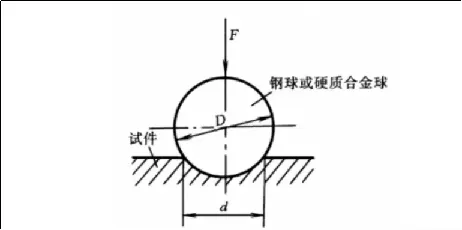
HThe difference between HBS and HBW lies in the type of indenter used. HBS refers to a test using a hardened steel ball as the indenter, typically employed for measuring Brinell hardness values in materials with hardness below 450, such as soft steels, gray cast iron, and non-ferrous metals. HBW, on the other hand, uses a carbide ball as the indenter and is used to measure Brinell hardness values in materials with hardness below 650.
For the same test piece and under identical testing conditions, the results from the two methods will differ, with HBW values often being higher than HBS values. However, there is no fixed quantitative relationship between the two.
Since 2003, China has adopted the international standard and replaced the use of hardened steel balls with carbide balls for Brinell hardness testing. As a result, HBS is no longer used, and HBW has become the standard notation for Brinell hardness. In many cases, HB is used alone to represent Brinell hardness, which typically refers to HBW. However, HBS may still be seen in some literature and academic papers.
The Brinell hardness test is suitable for materials like cast iron, non-ferrous alloys, and various annealed or tempered steels. It is not suitable for testing materials that are too hard, too small, too thin, or samples that cannot tolerate large indentations on their surfaces.
Rockwell Hardness
The method uses a diamond cone indenter with a 120° apex angle or a hardened steel ball as the indenter, in combination with a specific load configuration. The test starts with an initial load of 10 kgf, followed by the application of a total load (which is the sum of the initial load and the main load) of 60, 100, or 150 kgf. The indenter is pressed into the specimen under these loads sequentially. After the total load is applied, the hardness is determined by the difference in indentation depth between the depth under the initial load and the depth under the total load once the main load is removed, while the initial load remains.
This method is typically used in Rockwell hardness testing. The indentation depth under the initial load and the total load is used to calculate the hardness value, which reflects the material's resistance to indentation under both loads.

The Rockwell hardness test uses three different test forces and three types of indenters, resulting in nine possible combinations, each corresponding to one of the nine Rockwell hardness scales. These nine scales cover nearly all commonly used metallic materials. The most commonly used scales are HRA, HRB, and HRC, with HRC being the most widely applied.
Common Rockwell Hardness Testing Standard Table
|
Hardness symbols |
Types of Indenters |
F/N(kgf) |
Hardness scope |
Applications |
|
HRA |
120°Diamond cone |
588.4(60) |
20~88 |
Carbide, cermet, and surface-hardened steels |
|
HRB |
Ø1.588mm Hardened steel ball |
980.7(100) |
20~100 |
Annealed and normalized steels, aluminum alloys, copper alloys, cast iron |
|
HRC |
120°Diamond cone |
1471(150) |
20~70 |
Quenched steel, tempered steel, and deep surface-hardened steel |
The HRC scale is typically used for hardness values ranging from 20 to 70 HRC. When the hardness value is below 20 HRC, the sensitivity of the test decreases because the conical tip of the indenter penetrates too deeply into the material. In this case, the HRB scale should be used instead, as it is more suitable for softer materials.
When the hardness of the specimen exceeds 67 HRC, the pressure at the tip of the indenter becomes too high, which can damage the diamond and significantly shorten the lifespan of the indenter. Therefore, it is generally recommended to switch to the HRA scale for materials with a hardness greater than 67 HRC.
The Rockwell hardness test is simple to operate, quick, and produces small indentations, making it suitable for testing finished product surfaces as well as harder and thinner workpieces. Due to the small indentation, the hardness value can fluctuate more significantly for materials with uneven microstructures or hardness, resulting in lower accuracy compared to the Brinell hardness test. The Rockwell hardness test is commonly used to measure the hardness of steels, non-ferrous metals, carbide materials, and other alloys.
Vickers Hardness
The principle of Vickers hardness measurement is similar to that of Brinell hardness. A diamond pyramid indenter with an included angle of 136° is used, and a specified test force F is applied to the material's surface. After maintaining the load for a specified period, the test force is removed. The hardness value is determined by the average pressure exerted on the unit surface area of the square-based pyramid indentation, and the hardness value is denoted by the symbol HV.

The Vickers hardness test has a wide measurement range, capable of measuring materials with hardness values ranging from 10 to 1000 HV. The indentation is small, making it particularly suitable for measuring thinner materials and surface-hardened layers, such as carburized or nitrided surfaces.
Leeb Hardness
In the Leeb hardness test, an impact body with a tungsten carbide ball indenter is used to strike the surface of the specimen under a specific force, causing it to rebound. Due to the varying hardness of the material, the rebound speed differs. The impact device is equipped with a permanent magnet, and as the impact body moves up and down, the surrounding coil generates an electromagnetic signal that is proportional to the rebound velocity. This signal is then converted into the Leeb hardness value through an electronic circuit, and the value is denoted by the symbol HL.
The Leeb hardness tester does not require a workbench; its hardness sensor is as small as a pen and can be operated directly by hand. This makes it easy to test large, heavy workpieces or geometrically complex specimens without difficulty.
Another advantage of the Leeb hardness tester is that it causes very minimal surface damage to the product, and in some cases, it can be used for non-destructive testing. It is particularly unique for hardness testing in various directions, narrow spaces, and specialized areas, where other methods may be challenging to apply.


