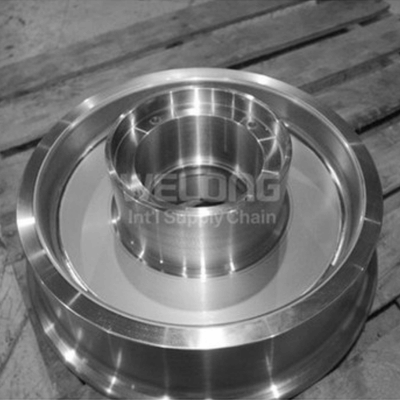

A common practice in CNC machined part manufacturing is to reduce the chance of damage or injury from sharp corners on the part. To solve this problem, machinists remove part of the 90-degree angle, creating a chamfer, also called a bevel. Although the terms "bevel" and "chamfer" tend to be interchangeable in practice, there are clear differences. Let's take a moment to examine the differences between bevels and chamfers and see how CNC machining uses these features when manufacturing parts.
Define the difference between bevel and chamfer
The terms "bevel" and "chamfer" describe the same geometric feature in a part, but with some differences. Defining them in detail helps discern the differences:
CNC machining bevel
A bevel is a slanted edge between two major faces of a part that facilitates connection to another face. Bevel angles can be measured at any angle except 45 degrees, and they help improve wear resistance, safety and aesthetics. For example, bevels are present in the blades of cutting tools, mirrors, and glass furniture to prevent injury from the sharp edges of glass.
CNC machining chamfering
Unlike a bevel that connects one CNC machined part to another, a chamfer transitions between two right-angled surfaces on the same part. Unlike bevels, chamfers are always at a 45-degree angle. Chamfering removes sharp edges at 90-degree angles on parts to prevent injuries during handling. Chamfering also protects the corners of the part from damage, thereby improving the overall integrity of the part.
Operators will use a chamfer mill, or "cutter," when CNC machining a part to create bevels or chamfers in the machined part. Beveling may require more passes to complete and generally involves a larger area to be cut than chamfering, but this is subjective. Additionally, the dual chamfer end mill can cut chamfers on the top and bottom of the workpiece without turning it over. Machine shops find these tools very versatile as they can be used for chamfering, chamfering, deburring, spotting and countersinking. However, bevels and chamfers can increase the manufacturing cost of the part, as discussed below.
Countersinks and other chamfer features that save money
While the aesthetic uses of chamfers should be carefully examined to avoid unnecessary manufacturing costs, there are some cost-effective applications of chamfers. For example, countersinking a threaded hole helps avoid creating burrs during the tapping process, which can affect how two mating surfaces hold together.
Countersinks also help bolts align correctly initially and avoid costly cross-threading during assembly. For some holes, such as aircraft rivets, accurate countersinking is so important that they require tight tolerances to ensure there is a sufficient amount of mating material available to make a secure connection.
Another cost-effective use of chamfers is on internal features of CNC machined parts. Designing chamfers into the features of the part rather than grinding the corners flat will reduce the cost of manufacturing the part. Chamfering will reduce the time required to cut right angles in parts and allow the use of cheaper tools. Internal chamfers also help prevent dust and waste from accumulating in the corners of the part.
Considering all of these issues before designing a bevel or chamfer into a part provides advantages. If the design does not require these features, excluding them will simplify manufacturing, saving time and money. On the other hand, if the design does require them, the impact on production time and expense can still be reduced. One approach is to provide large tolerances to simplify the fabrication of bevels and chamfers if exact dimensions are not critical. Another option is to remove the chamfer feature from the CAD model entirely and add a note on the 2D drawing instructing the CNC shop to "remove all sharp edges."
Shenzhen Weimaite Hardware and Plastic Products Co., Ltd. is mainly engaged in the production and manufacturing of non-standard precision hardware parts. It has been deeply involved in the industry for many years and has rich experience. If you have CNC processing, CNC lathe processing, five-axis processing service needs for aluminum, copper, stainless steel, iron, titanium alloy, plastic and other products, you can contact Wemet, and we will provide you with low-cost and high-quality products. All-in-one solution.