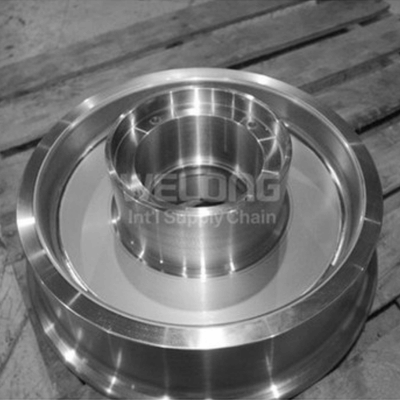

The basic processes of powder metallurgy are as follows:
1. Preparation of raw material powder. Existing milling methods can be roughly divided into two categories: mechanical methods and physical and chemical methods. Mechanical methods are divided into mechanical grinding and atomization, and physical and chemical methods are divided into electrochemical corrosion, reduction, chemical, reduction and chemical methods, vapor deposition, liquid deposition and electrolysis. The most widely used among them are reduction, atomization and electrolysis.
2. Molding the powder into a block of the desired shape. The purpose of molding is to produce a green body of a certain shape and size and give it a certain density and strength. Molding methods are basically divided into pressure molding and pressureless molding. The most widely used method of pressure molding is compression molding. In addition, 3D printing technology can also be used to create embryo blocks.
3. Sintering of green blocks. Sintering is an important process in powder metallurgy. The green body is sintered to obtain the required final physical and mechanical properties. Sintering is divided into single-component sintering and multi-component sintering. For single-component and multi-component solid-phase sintering, the sintering temperature is lower than the melting point of the metals and alloys used. For multi-component liquid phase sintering, the sintering temperature is usually lower than the melting point of the refractory component, but higher than the melting point of the fusible component. In addition to normal sintering, there are also special sintering processes such as loose sintering, melt infiltration, and hot pressing.
4. Post-processing of products. Post-sintering processing can be carried out in various ways according to the requirements of the product. Finishing, oiling, machining, heat treatment, electroplating, etc. In addition, in recent years, new processes such as rolling and forging have also been applied to the post-sintering processing of powder metallurgy materials, and relatively ideal results have been obtained.
Powder properties
A general term that describes all the properties of powder. This includes the geometric properties of powder (particle size, specific surface area, pore size and shape, etc.), the chemical properties of powder (chemical composition, purity, oxygen content, acid-insoluble substances, etc.), the mechanical properties of powder (loose density, flowability, moldability, compressibility, stacking angle, shear angle, etc.), the physical properties and surface properties of powder (true density, gloss, wave absorption, surface activity, zeta potential, magnetism, etc.). In many cases, the performance of powder metallurgy products is greatly affected by the properties of the powder.
The most basic geometric property is the particle size and shape of the powder.
(1) Particle sizeThis affects the processing and shaping of the powder, the shrinkage during sintering, and the final properties of the product. The performance of some powder metallurgy products is almost directly related to the particle size. For example, the filtration accuracy of the filter material can be empirically obtained by dividing the average particle size of the original powder particles by 10. The performance of cemented carbide products is closely related to the particle size of the WC phase. The only way to obtain cemented carbide with a finer particle size is to use finer WC raw materials. The particle size of the powder used in the manufacturing site ranges from hundreds of nanometers to hundreds of micrometers. The smaller the particle size, the more active it is, and the easier it is for the surface to oxidize and absorb water. When the particle size is as small as hundreds of nanometers, it is not easy to store and transport the powder. In addition, when the particle size is reduced to a certain extent, quantum effects come into play, causing dramatic changes in physical properties. For example, ferromagnetic powder becomes superparamagnetic powder, and the melting point decreases as the particle size decreases.
(2) Powder particle shapeDepends on the manufacturing method of the powder. For example, powder produced by electrolysis has dendritic particles, iron powder particles produced by reduction are sponge-like, and powder produced by gas atomization is basically spherical. In addition, the shape of the powder can also be elliptical, discoid, needle-like, onion-like, etc. The shape of the powder particles affects the flowability and loose density of the powder. Due to the mechanical interlocking between the particles, the compression strength of irregular powders is also large, especially dendritic powders have the highest compression strength. However, for porous materials, spherical powders are the best.
Mechanical properties The mechanical properties of powders are the process characteristics of powders and are important process parameters in the powder metallurgy molding process. The loose density of powders is the basis for volumetric measurement during pressing. The flowability of powders determines the filling speed of powders into the mold and the production capacity of the press. The compressibility of powders determines the difficulty of the pressing process and the level of pressure applied, and the moldability of powders determines the strength of the blank.
Chemical properties are mainly determined by the chemical purity of the raw materials and the milling method. Since a high oxygen content reduces the pressing performance, green strength and mechanical properties of the sintered product, most of the technical conditions for powder metallurgy have provisions in this regard. For example, the permissible oxygen content in powders is 0.2%-1.5%, which corresponds to an oxide content of 1%-10%.