


Introduction to quenching and tempering
In the field of metal heat treatment, quenching and tempering are two extremely critical and commonly used processes that play a decisive role in improving material properties. However, a question that has attracted much attention but still lacks a definitive answer is: How many times can quenching and tempering actually be repeated? The answer to this question involves multiple aspects, including materials science, heat treatment principles, and practical production applications, which will be discussed in detail below.
What Are Quenching and Tempering?
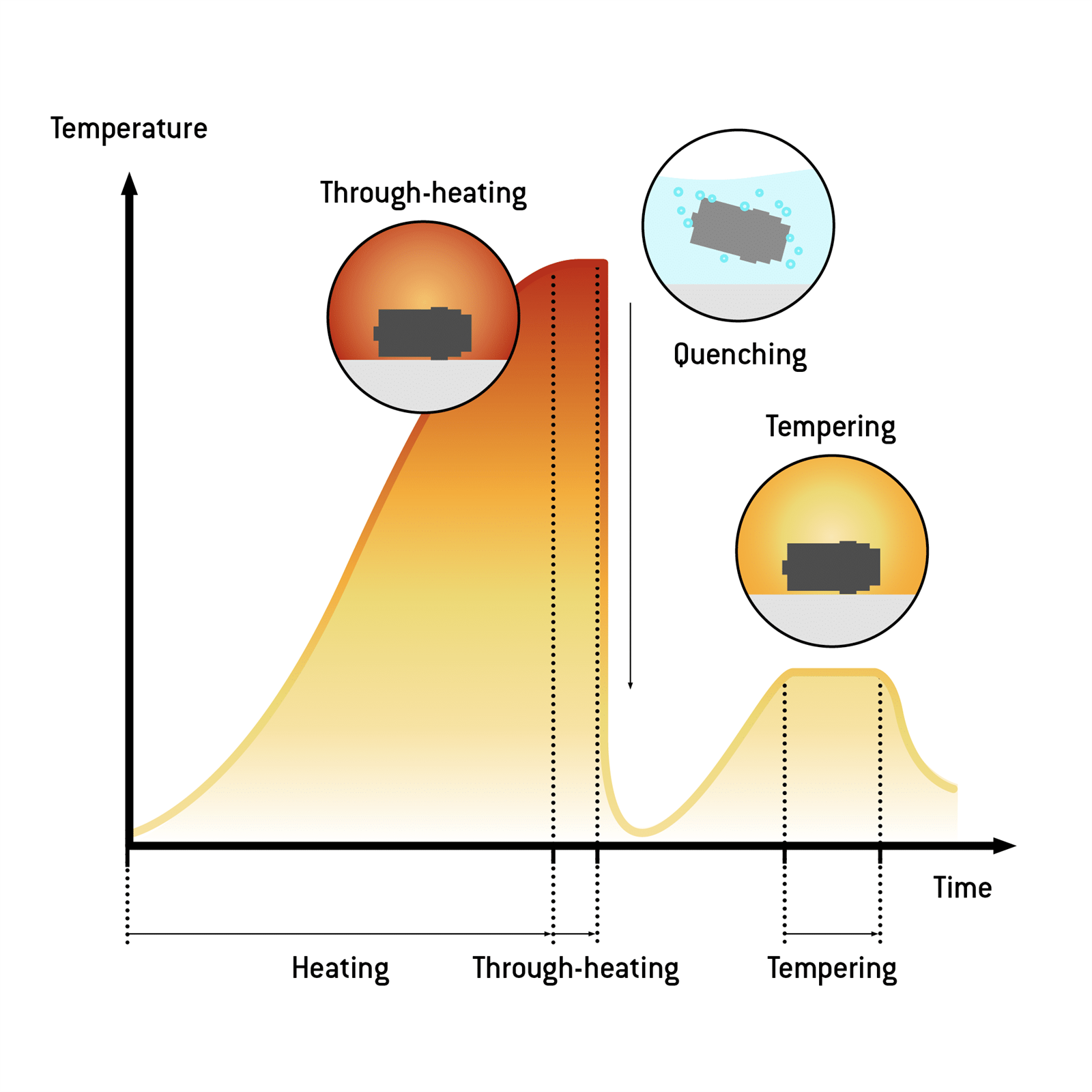
Quenching and tempering is a combined heat treatment process used to improve the mechanical properties of steel components by balancing hardness, strength, toughness, and wear resistance. During quenching, steel is heated to a high temperature above its critical point and then rapidly cooled in water, oil, or other cooling media. This process transforms the steel structure into hard martensite, significantly increasing hardness and strength. However, quenched steel is often brittle and contains high internal stress, so tempering is performed afterward. Tempering involves reheating the quenched steel to a controlled temperature and cooling it again to reduce brittleness, relieve stress, and improve toughness and dimensional stability.
This heat treatment process is widely used for heavy-duty forged and machined components that operate under high loads, impact forces, and repeated stress conditions. For example, in the automotive industry, quenching and tempering are applied to gears, shafts, and axles to improve wear resistance and fatigue life. In the oil and gas industry, components such as drill pipes, tool joints, and pressure-bearing parts require Q&T treatment to achieve high strength and toughness under harsh drilling environments. In heavy machinery and power generation equipment, forged shafts, gears, and structural components use this process to ensure reliable performance, longer service life, and resistance to deformation during continuous operation.
The
Difference between quenching and tempering
Although quenching and tempering are often performed together, they serve different purposes in controlling the final properties of steel. Quenching focuses on increasing hardness and improving resistance to deformation, while tempering focuses on adjusting the quenched structure to achieve a more practical balance of performance. Quenching rapidly cools heated steel, locking the carbon atoms into a hardened structure that provides high strength and excellent wear resistance. Tempering, on the other hand, modifies this hardened structure through controlled reheating, allowing engineers to fine-tune properties such as impact resistance, fatigue performance, and dimensional stability.
The choice between quenching and tempering depends on the operating requirements of the component. Parts that mainly require resistance to surface damage and mechanical stress, such as cutting tools, dies, and wear-resistant components, often emphasize the hardness gained from quenching. Components subjected to continuous loading, vibration, and sudden impact, such as industrial shafts, gears, construction machinery parts, and oilfield equipment, usually require both processes to avoid excessive brittleness while maintaining high load-carrying capability. In manufacturing, quenching creates the required strength foundation, while tempering optimizes the material performance for long-term operation in real working environments.

Basic Principles and Micro-Mechanisms of Quenching and Tempering
The Nature of Quenching and Microstructural Transformation
Quenching involves heating a metal material to an appropriate temperature (typically above the Ac3 or Ac1 critical point), holding it for a certain time to achieve full or partial austenitization, and then rapidly cooling it at a rate exceeding the critical cooling rate (usually in water, oil, or other cooling media) to obtain high-hardness microstructures such as martensite or bainite. The essence of this process is to suppress diffusion-based phase transformations through rapid cooling, achieving a diffusionless shear-type transformation, thereby obtaining a metastable martensitic structure.
During quenching, the material's cooling curve must avoid the "nose" of the C-curve to ensure that austenite does not decompose into pearlite or bainite. The formation of martensite is accompanied by volume expansion (approximately 1-1.5%), which generates significant structural and thermal stresses within the material. The accumulation of these internal stresses can not only cause material deformation but may also lead to cracking, particularly in high-carbon steels and components with complex shapes.
The Mechanism of Tempering
Tempering is a heat treatment process where the quenched material is heated to a temperature below the critical point (A1) (typically 150-650°C), held for an appropriate time, and then cooled. This process achieves microstructural stabilization through atomic diffusion:
- During low-temperature tempering (100-250°C), supersaturated carbon in the martensite precipitates as ε-carbide, forming tempered martensite, and internal stresses are partially relieved.
- During medium-temperature tempering (250-500°C), retained austenite decomposes, and martensite transforms into tempered troostite, significantly improving toughness.
- During high-temperature tempering (500-650°C), carbides coalesce and grow, forming tempered sorbit, resulting in excellent comprehensive mechanical properties.
During the tempering process, the nucleation, growth, and spheroidization of carbides, as well as the redistribution of alloying elements, all significantly impact the final properties.
Key Factors Influencing the Number of Possible Repetitions
Evolution of Material Composition and Microstructure
The tolerance of metal materials with different compositions to repeated quenching and tempering varies significantly. High-carbon tool steels (such as T8, T10), due to their high carbon content (0.8-1.0%), form high-carbon martensite after quenching, which is brittle and contains numerous microcracks. Each quenching cycle leads to:
- Repeated coarsening and refinement of austenite grains.
- Dissolution and reprecipitation of carbides.
- Increased segregation of impurity elements at grain boundaries.
Experimental studies show that after 3-4 repeated quenching cycles, the impact toughness of high-carbon steel decreases by about 15-20%, and crack sensitivity increases significantly.
In contrast, alloy structural steels (such as 40Cr, 42CrMo) exhibit better resistance to temper softening and grain growth due to the presence of alloying elements like Cr, Mo, and Ni. These elements increase the number of possible repetitions through the following mechanisms:
- Forming stable alloy carbides that inhibit grain boundary migration.
- Raising the recrystallization temperature delays the recovery process.
- Enhancing solid solution strengthening effects, maintaining microstructural stability.
Precise Control of Heat Treatment Process Parameters
The influence of quenching parameters on the number of repetitions is mainly reflected in the following aspects:
Temperature Control
The selection of quenching temperature directly affects the austenite grain size. With each quenching cycle, grains tend to coarsen. Using lower quenching temperatures (30-50°C above Ac3) and shorter holding times can effectively control grain growth. Research indicates that when the austenite grain size coarsens from grade 8 to grade 5, the fatigue life of the material decreases by approximately 30%.
Selection of Cooling Medium
The cooling characteristics of different media vary significantly:
- Water quenching: Fast cooling speed, but a large temperature difference between the inside and outside of the workpiece, leading to severe stress concentration.
- Oil quenching: Moderate cooling speed, more uniform temperature distribution.
- Martempering: Holding above the martensite start temperature (Ms) to reduce transformational stresses.
For repeated heat treatment, it is recommended to use media with moderate cooling intensity to avoid excessive thermal shock.
Optimization of the tempering process is equally important:
- Tempering temperature should ensure sufficient stress relief while avoiding excessive softening.
- Tempering time must allow for adequate precipitation and spheroidization of carbides.
- Multiple tempering cycles can more thoroughly eliminate retained austenite.
Engineering Considerations of Workpiece Size and Shape
Large workpieces (such as molds, rolls) face significant challenges during repeated quenching:
- When the cross-sectional thickness exceeds 100mm, it is difficult for the core cooling rate to reach the critical value.
- After multiple heat treatments, the surface decarburization layer accumulates, affecting fatigue performance.
- Thermal and transformational stresses superimpose, making deformation control difficult.
Stress concentration issues are more pronounced in complex-shaped workpieces (such as gears, cutting tools):
- Stress concentration areas like sharp corners and grooves are prone to quenching cracks.
- Non-synchronous phase transformation at junctions between thin and thick sections leads to complex internal stress distribution.
- Each heat treatment cycle accumulates deformation, affecting dimensional accuracy.
Engineering Practice in Practical Applications
Quality Control and Testing Methods
A comprehensive quality monitoring system needs to be established during repeated heat treatment processes:
- Hardness gradient testing before and after each heat treatment cycle.
- Ultrasonic flaw detection to check for internal cracks.
- Metallographic analysis to observe grain size and carbide distribution.
- Residual stress testing to assess the stress state.
Cost-Benefit Analysis
The economics of repeated heat treatment require careful consideration of:
- Direct costs: Energy consumption, equipment depreciation, labor costs.
- Quality costs: Scrap losses, rework costs.
- Opportunity costs: Delivery delays caused by extended production cycles.
Studies show that for general structural components, the number of repeated heat treatments usually does not exceed 3 times; for high-value molds, under strict process control, it can reach 5-7 times.
Typical Application Cases
Repeated Heat Treatment of Die Steels
When a softening layer appears on H13 hot work die steel during service, its performance can be restored through repeated quenching and tempering:
1. First, perform annealing to eliminate service-induced stresses.
2. Use vacuum quenching at 1030°C with staged cooling.
3. Temper twice at 580-600°C, for 2 hours each time.
4. The number of repetitions is generally controlled to 3 times.
Reconditioning Treatment of High-Speed Steel Tools
For worn W6Mo5Cr4V2 high-speed steel tools:
- First anneal to reduce hardness to 25-30 HRC.
- Heat using a salt bath furnace, quench from 1210-1230°C.
- Temper three times at 560°C, for 1 hour each time.
- Can be repeated 2-3 times while maintaining cutting performance.
Advanced Technologies and Future Development Trends
Intelligent Heat Treatment Systems
Modern heat treatment equipment improves the stability of repeated treatments through the following technologies:
- Multi-zone temperature control to ensure furnace temperature uniformity.
- Online monitoring and adjustment of cooling media.
- Automatic recording and tracing of process parameters.
- Optimization of heat treatment processes based on big data.
New Materials and Processes
The development of new materials offers possibilities for increasing the number of repeated heat treatments:
- Ultra-fine grained steels: High grain boundary density inhibits grain growth.
- Nano-precipitation strengthened steels: Nano-carbides improve tempering stability.
- Functionally graded materials: Composition designed according to the performance requirements of different parts.
Simulation and Prediction Technologies
Computer simulation plays an important role in repeated heat treatment:
- Temperature field simulation to predict cooling uniformity.
- Microstructure transformation simulation to forecast performance changes.
- Stress field analysis to assess deformation and cracking risks.
- AI-based optimization of process parameters.
How Manufacturers Control Quenching and Tempering Quality
The quality of quenching and tempering treatment depends not only on the heat treatment equipment but also on the precise control of every process parameter throughout production. For manufacturers producing forged and heavy-duty steel components, maintaining consistent mechanical properties requires strict control from material inspection to final performance verification.
Before heat treatment, manufacturers verify the steel grade, chemical composition, and forging condition to ensure the material meets the required specifications. Different alloy elements, such as carbon, chromium, molybdenum, and nickel, directly influence hardenability, cooling response, and final mechanical performance. Selecting the correct heat treatment parameters according to the material characteristics is essential for achieving stable results.
During the quenching and tempering process, key parameters, including heating temperature, soaking time, cooling rate, and tempering temperature, must be carefully monitored. Excessive heating may cause grain growth and reduce toughness, while insufficient heating may result in incomplete microstructure transformation. Similarly, improper cooling control can lead to excessive residual stress, deformation, or cracking, especially in large forged components.
After heat treatment, manufacturers evaluate the final condition of the components through mechanical testing and dimensional inspection. By combining controlled processing parameters with systematic quality verification, manufacturers can ensure that quenched and tempered steel parts achieve the required hardness, strength, toughness, and long-term reliability for demanding industrial applications.
Quenching and Tempering Parameters for Different Steel Materials
Different steel grades require different quenching and tempering parameters because their chemical composition determines their hardenability, transformation behavior, and final mechanical properties. A professional heat treatment process must be developed according to the material grade, component size, and service requirements rather than applying a standard treatment method to all steel products.
For medium-carbon alloy steels such as 42CrMo4 and 4140, quenching and tempering are commonly used to achieve a combination of high strength and good toughness. These materials are widely applied in shafts, gears, oilfield tools, and heavy mechanical components because alloying elements such as chromium and molybdenum improve hardenability and help maintain mechanical properties after heat treatment.
For hot work tool steels such as H13, the heat treatment process focuses on maintaining strength, toughness, and thermal fatigue resistance under repeated high-temperature operation. Controlled heating and tempering cycles are required to obtain a stable microstructure capable of resisting thermal shock and deformation.
For high-strength alloy steels such as 4340, quenching and tempering are optimized to achieve excellent tensile strength and impact resistance, making them suitable for components exposed to heavy loads and cyclic stress conditions.
Therefore, selecting appropriate heat treatment parameters based on steel composition allows manufacturers to optimize the balance between hardness, toughness, fatigue resistance, and service life for different industrial applications.
Inspection Methods After Quenching and Tempering Treatment
After completing quenching and tempering treatment, a comprehensive inspection is required to verify whether the components achieve the expected mechanical properties and structural integrity. For critical forged parts used in industries such as energy, oil and gas, and heavy machinery, inspection is an essential step to ensure reliable performance during operation.
Hardness testing is one of the most common inspection methods used after heat treatment. It verifies whether the component reaches the specified hardness range and whether the hardness distribution is consistent between the surface and core. For large components, hardness mapping is often performed at multiple locations to confirm uniform treatment results.
Mechanical property testing, including tensile testing and impact testing, is used to evaluate the overall performance of the treated steel. Tensile testing measures key properties such as tensile strength and yield strength, while impact testing evaluates the material's ability to absorb sudden loading without fracture.
Metallographic examination is performed to analyze the internal microstructure after quenching and tempering. It helps confirm the formation of the expected tempered martensite structure, grain condition, and carbide distribution.
For large forged components, non-destructive testing (NDT) methods such as ultrasonic testing (UT) are also commonly applied to detect internal defects, cracks, or discontinuities that cannot be identified through surface inspection.
Through a combination of mechanical testing, microstructure analysis, and non-destructive inspection, manufacturers can verify that quenching and tempering treatment delivers consistent quality and meets the performance requirements of demanding industrial applications.
Conclusion
Quenching and tempering is a critical heat treatment process for improving the performance of steel components by precisely controlling material structure and mechanical properties. Through controlled heating, rapid cooling, and tempering treatment, manufacturers can achieve an optimized balance of hardness, strength, toughness, and fatigue resistance. However, the final quality of heat-treated components depends not only on the process itself but also on accurate material selection, strict parameter control, and comprehensive inspection methods.
For different steel grades, component sizes, and application conditions, the quenching and tempering process needs to be carefully adjusted to ensure consistent performance. Through professional process management and quality verification, heat-treated components can achieve improved durability, dimensional stability, and reliable operation in demanding environments such as energy equipment, oil and gas systems, heavy machinery, and industrial manufacturing.
With extensive experience in forged metal components, **Welong provides customized manufacturing solutions integrating forging, machining, and heat treatment processes. Our engineering team works closely with customers to optimize material selection, manufacturing processes, and quality requirements to deliver reliable components for various industrial applications.
For customized quenching and tempering solutions or forged steel components, please contact Welong at metal@welongpost.com
FAQ
Q: What is quenching and tempering, and why is it used for steel components?
A: Quenching and tempering is a combined heat treatment process used to improve the mechanical properties of steel components. Quenching rapidly cools heated steel to increase hardness and strength by forming a martensitic structure, while tempering reheats the quenched steel to reduce brittleness and improve toughness, fatigue resistance, and dimensional stability. This process is widely used for components that require high strength and reliable performance under heavy loads.
Q: What is the difference between quenching and tempering?
A: Quenching is a hardening process that increases the hardness and wear resistance of steel through rapid cooling after heating. Tempering is a follow-up process that adjusts the properties of quenched steel by relieving internal stress and improving toughness. Together, these two processes provide a balanced combination of strength, durability, and impact resistance for industrial components.
Q: What types of steel materials can be treated by quenching and tempering?
A: Quenching and tempering is commonly applied to medium-carbon steels and alloy steels such as 4140, 42CrMo4, 4340, and H13 tool steel. The heat treatment parameters are adjusted according to the chemical composition, component size, and required mechanical properties to achieve the desired performance.
Q: What are the main steps of the quenching and tempering heat treatment process?
A: The process typically includes three main stages: heating, quenching, and tempering. First, the steel component is heated to the required austenitizing temperature and held until the structure becomes uniform. It is then rapidly cooled in a suitable medium such as oil, water, or polymer solution to increase hardness. Finally, the quenched component is reheated at a controlled temperature to improve toughness and stabilize the material structure.
Q: Why is tempering necessary after quenching?
A: Tempering is necessary because freshly quenched steel has high hardness but may also have excessive brittleness and internal stress. Through controlled reheating, tempering reduces these stresses, improves toughness, and prevents cracking during actual service conditions while maintaining sufficient strength.
Q: How do manufacturers control the quality of quenching and tempering treatment?
A: Manufacturers control heat treatment quality by monitoring key parameters such as heating temperature, holding time, cooling rate, and tempering conditions. After treatment, components are inspected through hardness testing, tensile testing, impact testing, metallographic analysis, and non-destructive testing to verify mechanical performance and structural integrity.
Q: What are the common applications of quenched and tempered steel components?
A: Quenched and tempered steel components are widely used in industries requiring high strength and durability, including oil and gas equipment, heavy machinery, power generation, automotive systems, and industrial manufacturing. Typical applications include forged shafts, gears, drill pipes, tool joints, turbine components, and other load-bearing parts.


