


Introduction
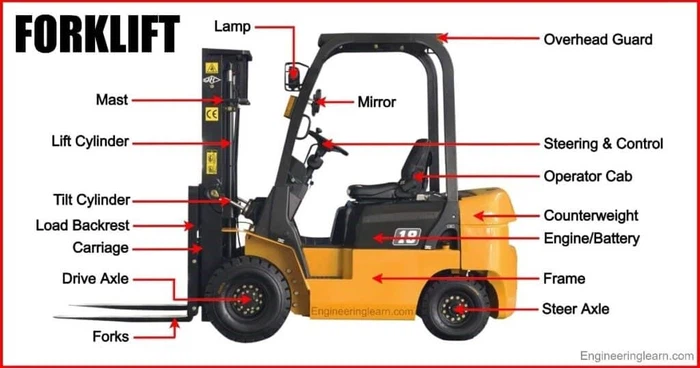
14 Parts of Forklift and Their Functions [Complete Guide]: – There are numerous industries or enterprises that rely upon the ability to efficiently move products and materials in a warehouse for shipping, storage, and different purposes. Any failures or interference of the material movement can lower the productivity of an organization and hurt its bottom line.
This makes it critical to not just have a good system set up to move materials efficiently, but also to have quality, dependable equipment to take care of business. One of the most important pieces of equipment used to move materials in a large number of settings, from factories and warehouses to retail stores, is the forklift.
What is a Forklift?
A forklift is a powered industrial truck that is used to lift and move materials over short or brief distances. Also called fork truck, is a motor-driven industrial truck utilized for lifting and moving goods on a pallet inside the premises of a warehouse, storerooms, and distribution centers. The forks take the weight or heaviness of the load as one with the carriage of the truck. Forklifts serve the necessities of different industries, including distribution centers and other large storage facilities. Larger organizations have whole fleets of forklifts that they rely on routinely to ensure maximum efficiency of their material movement.
Forklifts are complex or perplexing pieces of equipment that are comprised of various parts and these forklift parts are themselves included parts like bearings, chains, and sprockets. The forklift is a remarkably flexible work vehicle designed for quickly moving heavy cargo loads through a distribution center or industrial worksite. Anyone who operates a forklift or deals with an operation utilizing these machines ought to acquire an understanding of what the parts of a forklift are.
What Are the Parts of a Forklift Called?

A forklift consists of multiple components that work together to lift, transport, and position heavy loads safely. Understanding the names and functions of these forklift parts helps operators choose the right equipment, perform routine maintenance, and improve workplace safety.
1. Truck Frame: ( Parts of Forklift )
The truck frame or casing of a forklift looks like the chassis of any car, it is the metal frame that an considerable lot of the important forklift parts are attached or joined, which includes the wheels and axles, engine, mast, counterweight, and overhead guard. In certain forklifts, tanks for fuel or hydraulic fluids are built into the truck frame.
2. Operator Cab:
The operator cab is one of the most important parts of a forklift truck. It is the area where the forklift driver sits to operate or work the equipment. The cab contains a variety of forklift controls and working parts used to move and control the forklift. On some forklifts, the cab includes a seat for the operator, while others are designed for standing operation. The steering system within a forklift typically utilizes a hydraulic steering system and turns the rear axle while pivoting on the front tires.
Below are the levers that are found in operator cabs are discussed below: –
·Tilt lever: – They are utilized to adjust the angle of the forks.
·Lift lever: – They are utilized to lift the forks up and down.
·Side shift lever: – They are utilized to evenly move the carriage.
The overhead guard is an extension of the operator cab that supports a metal rooftop over the head of the operator. On certain forklifts, the cabs might be enclosed and include heating and cooling.
3. Counterweight:
4. Forklift Mast: ( Parts of Forklift )
The forklift mast is responsible for the principal capability of the forklift. It is the upward or vertical assembly toward the front of the forklift which comprised interlocking rails that lift the forks as well as the carriage with the load. These rails are powered by no less than one hydraulic cylinder, either directly or with chains driven by the cylinders.
Ordinarily, forklift masts comprise tilt and lift cylinders: –
(A) Tilt Cylinder
The purpose of the tilt or Slant chamber is to control the tilt or slant of the carriage as well as the fork's angle.
(B) Lift Cylinder
The lift cylinder drives the vertical movement of the load on the mast. This is generally a solitary acting cylinder and not entirely set in stone, determined by the mast size and number of stages. Contingent upon the amount of use and load size, lift cylinders might require replacement over the life of the truck.
It is feasible for a forklift mast to incorporate numerous stages that will expand the height of lift as well as weight capacity.
5. Power Source: ( Parts of Forklift )
Forklifts have two principal power sources: an internal combustion engine or, on account of electric forklifts, an electric engine powered by a battery or fuel cells. Forklifts with an internal combustion engine can burn gas, LP gas, CNG, or diesel fuel. These engines are like combustion engines in vehicles, infusing liquid fuel and air into a cylinder with a piston that is controlled by a crankshaft (driving rod). A spark plug starts the explosion that pushes the piston down in the cylinder, and the descending energy is further converted into mechanical energy to power the forklift. Combustion engines of forklifts are comprised of numerous internal components, which include chains, gears, and bearings that keep them functioning in an appropriate manner.
6. Forklift Carriage: ( Parts of Forklift )
The carriage is a significant part of the mast that is utilized to lift and stabilize the load. The forks and load backrest are, by and large, considered parts of the carriage: –
(A) Forks
The forks are the protruding bits of metal at the lower part of the carriage that is used to lift the load (heap) from the base. They arrive in a range of widths, lengths, and sizes to suit various purposes.
(B) Load Backrest
This is the flat surface along the back of the carriage that assists with supporting the load. Operators can rest the load against the backrest, and the backrest additionally prevents the load from sliding back into the operator.
7. Brakes: ( Parts of Forklift )
Forklift brakes are comprised of brake shoes as well as a brake drum. They are engaged by means of a foot pedal or a handbrake. Various modern-day electric forklifts have regenerative braking, which uses the electric motor to slow the forklift, with the energy generated used to charge the battery.
8. Swing Cylinders: ( Parts of Forklift )
A few trucks have swing cylinders. These cylinders permit the load to swing left or right up to 90°, relying upon application. They may be an essential part of a scissor expansion that pushes the load forward away from the mast to allow the swing cylinders to lock in.
9. Cab Enclosure: ( Parts of Forklift )
Cabs may be open or enclosed depending on safety concerns or the environment:-
(A) Seat
In "sit-down" forklifts, the driver's seat is positioned or situated to permit the operator full reach of all controls. In electric lifts, the seat also acts as an auto-off, meaning that when the operator stands or leaves the forklift, power to the lift is cut.
(B) Lever Controls
The lever controls allow the operator to engage the lifting mechanisms to manipulate the load. These levers include:
Tilt Lever – This lever controls the angle of the forks relative to the ground.
Lift Lever – Lift lever engages the lift mechanisms on the mast.
Side Shift Lever – This Lever allows the load to be moved a few centimeters left or right.
Swing Lever – For trucks with a swing mechanism, such as those used for racking systems, the swing lever allows the load to be turned up to 90° left or right. This system will likewise include or incorporate a scissor mechanism and an extension lever that permits the swing load to be pushed forward for positioning inside a rack.
(C) Overhead Guard
In potentially hazardous environments, an overhead guard may be placed to protect the operator from falling debris or load failure when at height. Overhead guards may also be reinforced if needed.
10. Forklift Attachments: ( components of a forklift )
In some cases, a couple of forks don't work for the load you want to deal with on a forklift. Attachment permits your forklift to turn out to be more effective and versatile in taking care of unique materials and handling products. Most of these attachments allow for additional capability or support for large, heavy, or unconventional loads. The stability of a forklift can be significantly changed by an attachment.
11. Forklift Forks: ( Parts of Forklift )
There are many kinds of forklift forks, and each type will have various options for lengths, widths, profundities, as well as capacities.
12. Lamps: ( Parts of Forklift )
Forklifts have a few unique sorts of lamps, relying upon application. One of the most widely recognized is a lamp attached to the overhead guard. This lamp is a directional light source controlled or constrained by the operator. Like a spotlight, it is useful in providing spot lighting in truck closures, containers, and different spaces where loads are being placed or removed. Larger trucks that operate outside or around nighttime might have a formal set of headlights like those of an automobile.
The majority of the trucks have red and yellow tail lights to indicate and demonstrate braking, backing up, and turning. Contingent upon model and size, some may come with a yellow or red revolving safety light or a strobe light on the highest point of the truck.
13. Forklift Tires: (parts of a forklift truck)
Forklift tires are significant enough to provide the traction or footing that is needed to move the forklift in a safe and efficient way. There are a few kinds of forklift tires available, and forklifts might have different tire layouts. While most forklifts have four wheels, there are some that are utilized inside that have three-wheel layouts that can move in limited or restricted spaces.
By and large, forklift tires are one of the following two sorts:
(A) Pneumatic Tires
These tires are better suited for outdoor environments because they have the traction to handle rough and uneven surfaces. There are pneumatic tires that swell with air, and pneumatic tires are made using strong elastic.
(B) Cushion Tires
These tires are utilized inside on smooth, flat surfaces since they have low traction or footing. They are great for workspaces that require a small turning radius, and they are not difficult to maintain and are relatively inexpensive.
14. Warning Signals and Alarms: ( Parts of Forklift )
Forklift safety is critical as there is still a large number of injuries each year utilizing lifts within the work environment. To help with safe operation, numerous forklifts have alarms and signals when the truck is being used. Below are alarms that are used for safety purposes.
(A) Max Height Alarm
This alarm cautions the operator that the lifted load exceeds or surpasses the maximum rated weight for the lift.
(B) Backup Alarm
Automatically draws in when the lift is moving backward to warn workers and walkers close by.
(C) Low Power
It is critical to maintain power throughout the lift cycle. Low power indicators, for example, an electric charge indicator or a fuel gauge might emit an audible sound when fuel or power is excessively low.
(D) Horn
Many alarms and signals included on forklifts are automatically locked in. The horn, in any case, is constrained by the operator. This allows an extra admonition warning helpful in noisy environments and blind corners.
What are the main components of a forklift?
The main components of a forklift work together to provide lifting power, stability, maneuverability, and operator safety. While forklift designs vary depending on the application, most forklift trucks share the same core components, including the truck frame, mast, carriage, forks, counterweight, power source, hydraulic system, steering and braking systems, tires, and operator cab.
Each of these forklift components performs a specific function. The mast raises and lowers loads, the carriage supports the forks and attachments, the counterweight maintains balance during lifting, and the hydraulic system provides the force required for lifting and tilting operations. Meanwhile, the power source-whether electric, diesel, LPG, or gasoline-supplies the energy needed to operate the entire machine.
Understanding the components of a forklift is essential for selecting the right equipment, performing preventive maintenance, and ensuring safe operation. Regular inspection of critical forklift parts can reduce downtime, extend service life, improve productivity, and help meet workplace safety requirements across warehouses, manufacturing plants, construction sites, ports, and logistics centers.
For businesses purchasing replacement forklift parts or custom forklift truck components, choosing high-quality, durable components is equally important to ensure reliable performance and lower long-term operating costs.
Parts of a forklift and their functions
Understanding the parts of a forklift and their functions is essential for safe operation, routine maintenance, and selecting the right equipment for different material handling applications. Every forklift component is designed to perform a specific task, from lifting and transporting loads to maintaining stability and protecting the operator. Together, these forklift parts ensure reliable performance, operational efficiency, and workplace safety.
| Forklift Part | Primary Function |
|---|---|
| Truck Frame | Serves as the structural foundation that supports all major forklift components. |
| Operator Cab | Houses the controls, steering system, and operator seat or standing platform for safe operation. |
| Counterweight | Balances the weight of lifted loads and prevents the forklift from tipping forward. |
| Forklift Mast | Raises, lowers, and positions the forks using hydraulic cylinders and lift chains. |
| Power Source | Provides the energy required to operate the forklift, including electric batteries or internal combustion engines. |
| Forklift Carriage | Connects the mast to the forks or attachments and moves vertically during lifting operations. |
| Brakes | Allow the forklift to stop safely and maintain control while carrying heavy loads. |
| Swing Cylinders | Provide hydraulic movement for rotating or side-shifting certain forklift attachments. |
| Cab Enclosure | Protects the operator from weather, dust, noise, and harsh working environments. |
| Forklift Attachments | Expand the forklift's capabilities for handling specialized loads, such as drums, paper rolls, or cartons. |
| Forklift Forks | Support and lift pallets or other materials during loading, unloading, and transportation. |
| Lamps | Improve visibility and enhance safety in low-light or nighttime operating conditions. |
| Forklift Tires | Provide traction, stability, and load support on indoor and outdoor surfaces. |
| Warning Signals and Alarms | Alert pedestrians and nearby workers to improve workplace safety and reduce accident risks. |
What Materials Are Forklift Parts Made Of?
Different forklift components are manufactured from different materials depending on their function and working conditions.
| Component | Common Materials |
|---|---|
| Truck Frame | High-strength structural steel |
| Forks | Forged alloy steel |
| Mast | High-strength steel |
| Carriage | Welded structural steel |
| Counterweight | Cast iron or cast steel |
| Hydraulic Cylinders | Alloy steel with chrome-plated rods |
| Attachments | Alloy steel or wear-resistant steel |
| Tires | Solid rubber, polyurethane, or pneumatic rubber |
How Can High-Quality Forklift Parts Reduce Operating Costs?
Although premium forklift parts may have a higher initial purchase price, they often provide greater value over the long term. Precision-manufactured components typically offer:
Longer service life
Higher load reliability
Reduced maintenance frequency
Lower equipment downtime
Improved operational safety
Better return on investment
For businesses operating forklifts in demanding environments such as warehouses, manufacturing plants, ports, and construction sites, investing in durable forklift truck parts can significantly reduce the total cost of ownership.
Choosing a Reliable Forklift Parts Supplier
Selecting a dependable supplier is just as important as choosing the right forklift parts. An experienced manufacturer should provide:
ISO-certified quality management
Material traceability
Precision machining capabilities
Strict dimensional inspection
Heat treatment and surface finishing options
Custom manufacturing based on drawings or samples
Technical engineering support
Stable production capacity and on-time delivery
At Welong, we meet all of these requirements through a comprehensive quality management system and over 20 years of manufacturing experience. Our engineering team works closely with customers to develop custom forklift parts based on drawings, samples, or technical specifications. Every component undergoes strict quality inspection before shipment to ensure reliable performance, consistent quality, and on-time delivery.
Working with a professional supplier like Welong helps ensure that replacement forklift parts meet performance requirements while minimizing downtime, reducing maintenance costs, and improving long-term equipment reliability.
Conclusion
In heavy-use conditions, many parts will require replacement while others will last the lifetime of the forklift. Notwithstanding, a strong maintenance program and diligent service in conjunction with a decent working knowledge of the parts of the forklift purchased will provide a long-term profit from the venture and one that is safe for all involved. With such an operational success riding on forklifts, keeping them serviced and in legitimate running condition is principal for any organization. Furthermore, because of the type of work they do and the conditions in which they operate, owners and support staff should understand the construction and parts of a forklift to keep them in service.
Reference Sources
Toyota Material Handling: Forklift Components and Operator Safety – Provides professional guidance on forklift components, operating principles, and safe material handling practices.
Hyster: Forklift Parts, Components, and Maintenance – Covers the functions of forklift parts, preventive maintenance, and equipment performance.
Crown Equipment Corporation: Forklift Technology and Material Handling Solutions – Explains forklift design, key components, safety features, and warehouse applications.
Yale Lift Truck Technologies: Forklift Equipment and Replacement Parts – Discusses forklift truck components, maintenance recommendations, and replacement parts.
Frequently Asked Questions (FAQs)
Q: What is the function of the forklift mast?
A: The forklift mast is the vertical lifting assembly that raises and lowers the forks and carriage. Powered by hydraulic cylinders and lift chains, it allows the forklift to lift materials to different heights while maintaining load stability.
Q: Why is the counterweight important on a forklift?
A: The counterweight balances the weight of the load being lifted to prevent the forklift from tipping forward. It is specifically engineered to match the forklift's rated load capacity, making it a critical safety component.
Q: What are forklift attachments used for?
A: Forklift attachments expand the capabilities of standard forklifts by allowing them to handle specialized loads. Common attachments include paper roll clamps, bale clamps, side shifters, fork positioners, rotators, drum handlers, and work platforms, helping improve productivity across different industries.
Q: How often should forklift parts be inspected?
A: Forklift parts should be visually inspected before each shift, while scheduled preventive maintenance should follow the manufacturer's recommendations. Regular inspection of the forks, mast, hydraulic system, brakes, tires, lift chains, and steering components helps improve safety, reduce downtime, and extend equipment life.
Q: Which forklift parts wear out the fastest?
A: Frequently replaced forklift parts include forks, lift chains, hydraulic seals, hoses, tires, brake pads, bearings, rollers, and filters. These components experience continuous wear during daily operation and should be replaced when they no longer meet safety or performance requirements.
Q: How do I choose high-quality forklift parts?
A: When selecting forklift truck parts, consider material quality, manufacturing precision, dimensional accuracy, load capacity, corrosion resistance, and compatibility with your forklift model. Working with an experienced manufacturer that offers ISO-certified quality management, material traceability, and engineering support helps ensure reliable performance and longer service life.
Q: Can forklift parts be customized?
A: Yes. Many forklift parts can be custom-manufactured based on customer drawings, samples, or technical specifications. Common custom components include carriage frames, mast components, brackets, supports, forks, and other structural parts designed for specific forklift models or operating conditions.


