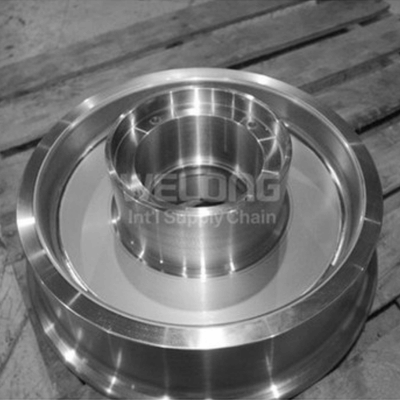

Centrifugal casting is an advanced process widely used in the foundry industry. Through the action of a rotating mold and centrifugal force, the metal melt is injected and solidified in a state of high-speed rotation. This process has many advantages, such as improving product quality, reducing defect rates, increasing production efficiency, etc. The following is a brief introduction to the centrifugal casting process.
Process flow:
◆Mold preparation: First, make a rotatable mold according to the shape and size of the desired product. Molds are usually made of high-temperature-resistant materials to withstand high-speed rotation and the pressure of metal liquids.
◆Melting materials: Melting appropriate metal materials (such as steel, iron, aluminum, etc.) and ensuring that they remain liquid under appropriate melting points and melting conditions.
◆Injecting metal liquid: Pour the molten metal material into the center of the rotating mold, and use centrifugal force to evenly distribute the metal liquid along the mold wall.
◆Solidification process: As the mold rotates, the metal liquid gradually cools and solidifies. Due to the centrifugal force, the metal forms a uniform solidification structure on the mold wall.
◆Mold opening and product removal: After the metal is completely solidified, stop the mold rotation, open the mold and remove the solidified casting.

The centrifugal casting process can be used for casting a variety of materials. Here are some commonly used centrifugal casting materials and their advantages:
◆Aluminum alloy: Aluminum alloy has good fluidity and solidification properties in centrifugal casting. Centrifugal casting enables the manufacture of aluminum alloy castings with high precision and complex shapes while providing excellent surface quality and mechanical properties.
◆Steel: Centrifugal casting is widely used in the production of steel castings such as stainless steel, carbon steel and alloy steel. Centrifugal casting can effectively control the solidification process of molten steel, reduce the generation of pores and inclusions, and provide a uniform and dense organizational structure, thereby improving the strength and toughness of steel castings.
◆Nickel-based alloys: Nickel-based alloys have excellent properties such as high temperature resistance, corrosion resistance and oxidation resistance, and are widely used in the aerospace, energy and chemical industries. Centrifugal casting can realize the manufacturing of high-quality and high-density nickel-based alloy castings to meet the requirements of complex working environments.
◆Titanium alloy: Titanium alloy has low density, high strength and excellent corrosion resistance, and is widely used in the aerospace and medical industries. Centrifugal casting enables efficient, precision manufacturing of titanium alloy castings, reducing defect rates and providing excellent mechanical properties.
◆Copper alloy: Centrifugal casting can be used in the casting of copper alloys such as brass and bronze. This process can ensure the uniformity and density of copper alloy castings, providing excellent thermal conductivity and corrosion resistance.

The centrifugal casting process is widely used in many industries and is mainly used to produce parts and castings with large, complex shapes and high quality requirements. The following are some common applicable product categories:
◆Automotive industry: engine block, crankshaft bearings, gear seats, etc.
◆Energy industry: turbine blades, gas turbine bearings, burner nozzles, etc.
◆Aerospace: turbine engine blades, engine casings, combustion chamber components, etc.
◆Chemical and petroleum industries: reactor tanks, pump housings, pipe connections, etc.
◆Steel industry: continuous casting rolls, guide rolls, rolling mill rolls, etc.
The centrifugal casting process offers several advantages, including:
◆Reduce defect rate: Centrifugal casting uses centrifugal force to form a uniform structure of the metal liquid during the solidification process, reducing the occurrence of defects such as pores and inclusions. This improves product quality and reliability.
◆Improved product quality: Centrifugal casting enables the manufacture of castings with high precision and complex shapes. Through the rotation of the mold and the action of centrifugal force, the metal liquid remains evenly distributed throughout the solidification process, ensuring the dimensional stability and surface quality of the product.
◆Increase production efficiency: Compared with traditional casting processes, centrifugal casting can quickly complete the filling and solidification process of metal liquid. This means shorter production cycles and higher production efficiency, which helps meet customer needs and enhance corporate competitiveness.
◆Wide adaptability: The centrifugal casting process is suitable for various metal materials, such as steel, iron, aluminum alloys, etc. Whether it is aluminum alloys with low melting points or steels with high melting points, centrifugal casting can meet the needs of different industries and application fields.
◆High flexibility and customizability: Centrifugal casting enables a high degree of customization in product shape and size. By adjusting mold design and process parameters, parts and castings of various complex shapes can be produced to meet customers' special requirements.
◆Material cost savings: Because centrifugal casting has a lower defect rate and high precision, it reduces the need for scrap and secondary processing, thereby saving material costs.
In short, the centrifugal casting process has been widely used in the foundry industry due to its excellent product quality, efficient production and wide adaptability. This process not only provides high-quality and precision castings, but is also able to meet various customization needs, giving manufacturing companies a huge competitive advantage.