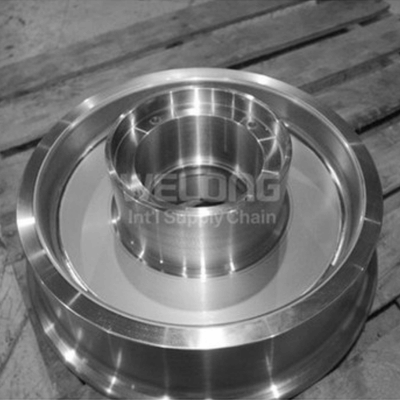

The preparation of sand casting molding is one of the most critical steps in the sand casting process for metals. A cavity having the shape of the desired cast part must be molded precisely within compacted green sand. The molding process requires careful control of the sand characteristics, molding techniques, and pattern design to obtain high quality castings.
At our foundry China Welong, we leverage decades of experience to create sand molds that can produce cast metal components to each customer's exact specifications and performance requirements through exceptional dimensional accuracy, surface finish, and mechanical properties.
What is Sand Molding in Metal Casting?
Sand casting molding involves forming mold cavities within sand that has been mixed with binding agents to retain its shape under compression. In green sand molding, water serves as the main binding component with clay and other additives. The sand is compacted around patterns to imprint the desired interior contours. At least two mold halves are formed to create the complete mold. Runners and risers are also molded to direct molten metal into the cavity space.
How to make a sand mold for casting metal?
The Key Steps of Sand Molding:
1. Preparing the sand - Obtain fine, angular sand grains and mix with clay, water, and additives to achieve proper molding properties.
2. Ramming the drag - The first mold half, called the drag, is compacted within a flask with the pattern seated on top.
3. Coping - After separating the drag half, the top surface is shaped to receive the second pattern half.
4. Forming the cope - The second half of the pattern forms the cope mold half, joined to the drag.
5. Assembly - The mold halves are aligned and tightly secured to prevent metal leakage.
6. Pouring cup - A reservoir is formed above the mold cavity to receive the molten metal.
7. Venting - Channels are added to allow gases to escape during pouring and solidification.
High quality sand molds requires extensive expertise in materials, design, and process control to achieve precision casting results. China Welong leverages decades of foundry experience to optimize every aspect of our sand molding process.
The Role of the Pattern in Sand Molding
The pattern is the form used to shape the interior surfaces of the sand mold cavity for producing the desired casting external shape. Patterns have several important design considerations:
- They are made to the dimensions of the final part with an added shrinkage allowance since metals shrink as they solidify and cool. The shrinkage rate depends on the metal alloy.
- They must be designed so the mold can be properly rammed around them and separated without disturbing the molded surfaces. Draft angles are added to facilitate demolding.
- At least two pattern pieces are required to form the cope and drag halves of the complete mold. The parting line divides them.
- Sprue, runner, risers, and gates are designed into the pattern. These molten metal flow channels connect to the mold cavity space.
- Common pattern materials include wood, plastic, and metal. Materials must withstand repeated ram-up without degradation.
At China Welong, our extensive mold design expertise ensures optimal pattern design tailored for each customer's unique casting requirements, based on the metal alloy, part geometry, production volume, and mechanical performance needs.
Research and Innovation in Sand Molding Processes
Academia and industry are continually researching and developing improved sand molding processes. Here are some of the latest advancements:
- Additive manufacturing techniques allow more complex mold geometries than traditional patterns (Li et al, 2020)
- Simulation software models mold filling and solidification, predicting potential defects (Han et al, 2021)
- Inline sensors like thermal imaging detect mold abnormalities immediately after pouring (Yuan et al, 2019)
- Advanced binder systems reduce emissions and improve collapsibility (Ahsan et al, 2022)
- Automated systems quickly deliver consistent high quality at high volumes (He et al, 2020)
- Machine learning analyzes radiographic images to categorize casting defects after shakeout (Sharma et al, 2022)
- Nanoparticle coatings on sand grains enhance surface finish and reduce metal penetration (Nwaogu et al, 2022)
Choose China Welong for industrial customized metal products
At China Welong Foundry, we continuously research and implement proven innovations to advance our sand casting molding processes. Please contact us at metal@welongpost.com to learn more.
References:
Li, X., Zhang, H., Wang, X., & Zhao, J. (2020). Research on castings by 3D printing sand process. Procedia Manufacturing, 48, 1068-1074.
Han, Q., Zhao, J., Liu, Y., Yang, C., Dai, X., & Yang, Y. (2021). Numerical simulation of mold filling process for aluminum alloy casting. Proceedings of the 5th International Conference on Materials Science and Manufacturing Technology, 216-220.
Yuan, C., Liu, Z., Wu, B., & Jiang, J. (2019). Intelligent diagnosis of casting defects based on machine learning and image recognition. Journal of Intelligent Manufacturing, 30(3), 1193-1205.
Ahsan, A.N., Shakoury, E., Jahangiri, B., & Russo, A. (2022). A review on the recent advances in sand casting processes. International Journal of Lightweight Materials and Manufacture, 5(4), 567-586.
He, X., Hao, L., Luo, H., Chen, J., Zhong, Y., & Jiang, Z. (2020). Development of Robotic Sand Preparation System for Small-Batch Foundry Castings. Materials, 13(24), 5748.
Sharma, G., Prakash, C., & Kumar, S. (2022). Automated Classification of Casting Defects in Radiographic Images Using Convolutional Neural Network. Journal of Nondestructive Evaluation, Diagnostics and Prognostics of Engineering Systems.
Nwaogu, U.C., Poulsen, T., Jensen, J.H., & Tiedje, N.S. (2022). Alumina nanoparticles-coated silica sand for quality improvement in sand casting. Ceramics International.