


In continuous galvanizing, the strip coming out of the zinc pot must be stable prior to the air knives setting the coating weight. Damp vibration and the submerged stabilizer rolls guide the strip and maintain it on track, which has a direct impact on the quality of the coating. China Welong has been a supply chain partner for bespoke metal goods since 2001 and explains how these rolls function and how to maintain them working at their best.
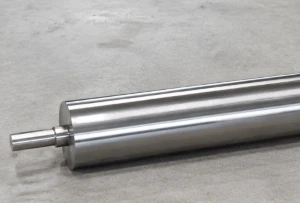
How Does a Stabilizer Roll Control Strip Vibration Before Air Knives?
Damping Strip Vibration at the Source
A stabilizer roll softly rides on the strip as it passes through the zinc bath, damping tiny oscillations resulting from variations in line speed and tension. Also, the stabilizer roll calms the strip early so vibration never reaches the air knives. The wiping jets contact a stable surface every time, even at high speed.
Correcting Strip Shape and Crossbow
When the strip comes up out of the pot, it frequently has minor crossbow or edge waves. A well-positioned stabilizer roll softly flattens the strip and guides it down a straight line, providing the air knives a uniform gap throughout the width and helping to produce an equal zinc coating from edge to edge.
Setting Roll Position and Pressing Depth
The depth of the press determines how much stabilizing force the strip gets. Operators set the stabilizer roll position to strip gauge, width, and speed, balancing tight control with a delicate touch. Careful preparation keeps the strip stable, preserves the surface, and provides reliable operating conditions for the air knives.
How Do Roll Runout and Bearing Wear Affect Strip Stability?
Why Roll Runout Matters
Runout occurs when the surface of the stabilizer roll does not turn exactly true, which might give the strip a repeated motion. Accurate machining and assembly keep runout within tight tolerances so that the stabilizer roll rides smoothly on the strip to maintain the steady route on which the air knives depend.
Bearing Condition and Rotation Smoothness
The bearings of a submerged stabilizer roll handle their weight in a difficult environment. Healthy bearings provide unrestricted, even rotation; early wear might add tiny differences. A stabilizer roll guarantees strip stability campaign after campaign, if bearings are used according to the circumstances and rotation is checked routinely.
Sleeve and Journal Fit
The sleeve and journal fit determines how steadily the roll rotates on its shaft. Proper clearances allow the stabilizer to roll and spin without wobbling even as the temperature increases. Accurate machining from accurate drawings ensures all components fit perfectly to allow smooth strip contact and consistent performance across lengthy production runs.
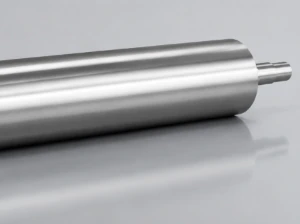
The Link Between Stabilizer Roll Performance and Coating Uniformity
Steady Strip Means a Stable Air Knife Gap
The air knives provide better performance if the distance to the strip is kept constant. The strip is kept in its proper plane by the stabilizer roll functioning correctly, so the air knife gap is constant. This stability ensures precise wiping and helps to maintain the correct coating weight over the whole strip length.
Edge-to-Edge Coating Consistency
You just need a level, quiet strip to cover from edge to edge. The stabilizer roll controls movement throughout the breadth so the air jets can clean zinc uniformly, decreasing the variance between the center and the margins. Customers have the advantage of a homogeneous surface and predictable coating weight.
Surface Quality and Appearance
The surface appearance shows the smoothness of transit of the strip through the pot. A smooth, precisely polished stabilizer roll makes gentle and consistent contact with the strip, contributing to a brilliant, uniform finish. Good roll condition helps galvanizing goods fulfill the stringent criteria of car, appliance, and construction applications.
How Can Stabilizer Roll Maintenance Reduce Air Knife Vibration and Defects?
Scheduled Inspection and Measurement
Each stabilizer roll is kept in production-ready condition by regular examination. When the line pauses, technicians measure roll diameter, surface quality, and rotation and record the data so they may be compared over time. This routine provides early performance information and enables teams to schedule servicing at opportune times, safeguarding both strip stability and productivity.
Timely Replacement of Roll Components
Regular replacement of sleeves, bearings, and bushings maintains the stabilizer roll running at its optimum. Spare parts built to your designs are to the original standard. This preparation reduces the maintenance time and allows the line to resume quickly with stable strip behavior.
Monitoring Air Knife Performance
Stabilizer roll state is commonly reflected in air knife stability and coating trends. Coating weight consistency and strip movement assist teams in determining when roll attention is beneficial. These insights relate to maintenance records, improve the timetable, and retain the stabilizer roll to ensure constant, high-quality coating.
Conclusion
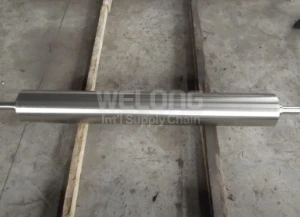
Submerged stabilizer rolls are critical to prepare the strip for the air knives. A well-set stabilizer roll provides regular air knife gaps and homogeneous coating by reducing vibration, flattening shape and retaining a steady course. The performance is kept dependable by low runout, good bearings, and tight fittings, and by regular examination and prompt replacement across many campaigns. With careful setup, quality components, and scheduled maintenance, plants benefit from more stable strip behavior, greater surface quality, and more productive lines. With reliable bespoke parts and technical support, Welong is ready to assist your galvanizing line in reaching that steadiness.
FAQ
1. What does a stabilizer roll do before the air knives?
It dampens strip vibration and keeps the strip on a steady path.
2. Why does roll runout matter?
Excess runout can pass a repeating motion to the strip and disturb coating.
3. How does strip stability affect coating?
A steady strip keeps the air knife gap constant, giving uniform coating weight.
4. How often should rolls be inspected?
Inspect them at every planned line stop and record the results.
5. Can replacement parts be made to my drawings?
Yes, China Welong produces customized parts from your drawings or samples.
Ready to Stabilize Your Strip and Improve Coating Quality? Contact China Welong Today
Every galvanizing line has its own needs, and the right stabilizer roll components start with your real operating conditions. Send your drawings, samples, or application details to metal@welongpost.com, and the China Welong team will reply with practical advice and a tailored quotation. With ISO 9001-certified service, 20 years of export experience, and in-house engineering support, we are ready to help your line run steadier.
References
1. Marder, A. R. "The Metallurgy of Zinc-Coated Steel." Progress in Materials Science, 45(3), 2000.
2. Tang, N.-Y. "Characteristics of Continuous-Galvanizing Baths." Metallurgical and Materials Transactions B, 30(1), 1999.
3. Ellen, C. H., & Tu, C. V. "An Analysis of Jet Stripping of Liquid Coatings." Journal of Fluids Engineering, 106(4), 1984.
4. Porter, F. C. Zinc Handbook: Properties, Processing, and Use in Design. CRC Press.
5. Rao, S. S. Mechanical Vibrations. Pearson.
6. Harris, T. A., & Kotzalas, M. N. Rolling Bearing Analysis: Essential Concepts of Bearing Technology. CRC Press.


