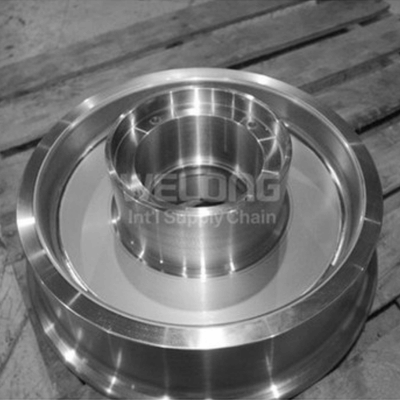

Q: What is the main scope of Welong’s products ?
A: Our products are divided into Ferrous and nonferrous metal according to the materials. The processes involved include sand casting, precision casting, forging, stamping, etc.
Ferrous refers to steel parts and iron castings. Iron castings are divided into gray iron, ductile iron and malleable iron. The casting processes used for iron castings include sand casting (resin / sodium silicate / ordinary Sand casting) and precision casting.
The normal Grey iron grades include GG10. GG15. GG20. GG25. GG30. GG35, etc.,
Ductile iron grades include GGG40, GGG42, GGG45, GGG50, GGG60, GGG70, etc.
Q: Which kind of heat treatment placed on iron castings?
A: Stress relieving annealing. After the grinding of gray iron raw castings, they are generally subjected to stress relieving annealing at temperatures ranging from 500 to 550 ℃. During the annealing process, the work piece is usually placed in the furnace below 200 ℃, heated to around 500-550 ℃, held for 1-2 hours, stopped heating, and cooled to room temperature in the furnace. Pay attention to cooling in the furnace.
Sometimes for GGG40 products, annealing is not necessary. This is because the graphite in GGG40 material improves the performance of the work piece and the chip cutting performance, which is a cost saving method. But for material GGG45 or higher grade must undergo annealing, otherwise there may be problems and difficulties during machining.

Q: Which kind of heat treatment placed on Steel castings?
A: The forming of steel parts differs between casting and forging. In principle, cast steel parts, like forgings, require normalizing rather than annealing. Some foundries have replaced annealing due to the lack of a normalizing furnace. The conventional normalizing temperature is between 850-900 ℃, and the purpose of normalizing is to refine the internal grains of steel parts and improve the microstructure.

For Tool steel (carbon Tool steel+alloy Tool steel) and bearing steel, spheroidizing annealing is carried out in order to obtain better hardness and strength in the subsequent quenching process.
Spheroidizing annealing is an annealing process that involves the spheroidization of carbides in steel, resulting in a structure of uniformly distributed spherical or granular carbides on the ferrite matrix.
There are many methods for spheroidizing annealing, and the two most commonly used processes are ordinary spheroidizing annealing and isothermal spheroidizing annealing.
Ordinary spheroidizing annealing. Heat the steel to 730-740 ℃ for sufficient time, and then slowly cool it to 650 ℃ at a rate of less than 20 ℃/h. This annealing process is suitable for carbon Tool steel near eutectoid composition.
Isothermal spheroidizing annealing. Generally, it is heated to 800 ± 10 ℃, and after insulation, it is quickly cooled to 700 ± 10 ℃ (near A1) for a longer period of insulation. Afterwards, it is cooled to 600 ℃ at a rate of 30-50 ℃/h and discharged from the furnace. This process is commonly used for bearing steel.
For steel parts with mechanical performance requirements, whether cast, forged, or bar material machining, heat treatment is carried out: quenching+ tempering. What we usually say about quenching and tempering is quenching + high-temperature tempering.
The hardness of quenching and tempering is generally below HB400. If the hardness is higher than this, it is quenching + low-temperature tempering.
Steel parts, especially alloy steel parts, must be normalized before quenching.
Q: Which kind of heat treatment placed on Aluminum castings?
A: Aluminum parts molding is divided into sand casting, gravity casting, die casting, and profile processing. Their heat treatment conditions are also different. Aluminum sand casting and gravity casting can undergo T5 heat treatment, while aluminum rod and plate processing parts can undergo T6 heat treatment. Aluminum die castings cannot undergo any heat treatment.
Differences between T5 and T6:
T5: After extrusion, it is air cooled and quenched, and then transferred to an aging furnace for insulation of about 200 degrees for 2-3 hours.
T6: Water cooled quenching is used, and the artificial aging temperature after quenching will be higher, and the insulation time will also be longer. The hardness of the obtained product varies.
Contact Tracy at sxwelong@welongpost.com for inquiries on castings and forgings.