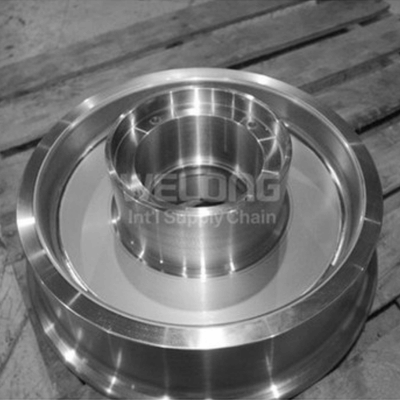

Forging is a premier manufacturing process known for producing parts with superior strength, toughness, and structural integrity. However, like any industrial process, it is susceptible to defects that can compromise the performance and safety of the final component. Effective defect analysis and correction are critical to maintaining quality, reducing scrap, and ensuring reliability. This article provides a systematic overview of common forging defects, their root causes, methods of detection, and, most importantly, practical solutions for prevention and correction.

1. The Importance of Defect Analysis in Forging
Defects in forgings can lead to catastrophic failures in critical applications such as aerospace, automotive, and oil & gas. A proactive approach to defect analysis-moving beyond simply identifying flaws to understanding their underlying causes-is essential for continuous process improvement. This involves a closed-loop system of detection, root cause analysis, corrective action, and verification.
2. Common Forging Defects: Causes, Identification, and Solutions
Defects can be categorized based on their origin: those arising from the starting material, the forging process itself, or post-forging operations.
Category 1: Defects Originating from the Billet/Ingot
1.1. Seams & Laps (Longitudinal Surface Defects)
Description: Sharp, longitudinal cracks or folds on the surface of the forging. They are often original flaws from the continuous casting or rolling of the starting stock.
Causes: Pre-existing cracks or deep scratches in the original billet that are elongated during the forging process. Inadequate conditioning (grinding) of the billet before forging.
Detection: Visual inspection, Magnetic Particle Inspection (MPI), Dye Penetrant Inspection (DPI).
Prevention/Correction: Implement stringent incoming material inspection. Ensure billets are properly conditioned to remove all surface imperfections. Use certified material suppliers.
1.2. Inclusions (Non-Metallic Inclusions)
Description: Non-metallic particles (e.g., oxides, sulfides, silicates) embedded in the metal matrix. They act as stress concentrators, drastically reducing fatigue life and toughness.
Causes: Impurities introduced during the steelmaking process (slag, refractories from the furnace lining).
Detection: Ultrasonic Testing (UT) is most effective for subsurface inclusions. Macro-etching can also reveal their presence.
Prevention/Correction: Source high-quality, "clean" steel from reputable mills. Use vacuum arc remelting (VAR) or electro-slag remelting (ESR) processes for critical aerospace components. In-process controls cannot remove existing inclusions.
Category 2: Defects Originating from the Forging Process
2.1. Laps or Folds (Process-Induced)
Description: Similar in appearance to seams but caused during forging. They occur when metal folds over itself during deformation but fails to weld shut.
Causes: Improper die design (sharp corners, insufficient fillet radii), incorrect positioning of the billet in the die, excessive flash, or using a billet that is too large.
Detection: Visual inspection, MPI, DPI.
Prevention/Correction: Optimize die design with generous fillet and corner radii. Ensure accurate billet volume and proper positioning. Adjust forging parameters (e.g., stroke speed, pressure).
2.2. Incomplete Die Fill
Description: Certain sections of the die cavity are not completely filled with metal, resulting in a forging that is missing material in specific areas.
Causes: Insufficient forging force, low billet temperature, poor die design (lack of vents), or a billet that is too small.
Detection: Visual inspection and dimensional checking against the CAD model.
Prevention/Correction: Increase forging tonnage. Ensure the billet is heated to the correct and uniform temperature. Modify die design to improve metal flow. Use a slightly larger billet.
2.3. Cold Shuts
Description: A line of oxide appears where two surfaces of metal have met but failed to weld together during forging. It looks like a crack on the surface.
Causes: The metal has cooled down excessively (below the forging temperature) before deformation is complete. This can happen due to slow transfer from furnace to die, or multiple hits in a press with too long a delay.
Detection: Visual inspection, MPI, DPI.
Prevention/Correction: Minimize the time between furnace and die ("transfer time"). Reheat the billet if necessary between forging operations. Optimize the number of presses and cycle time.
Category 3: Temperature-Related Defects
3.1. Overheating & BurningDescription:
Overheating: Excessive heating temperature or time causes rapid grain growth, leading to a coarse grain structure that reduces mechanical properties.
Burning: A more severe condition where the grain boundaries oxidize and melt, permanently destroying the material's integrity. Burned material is irreparable.
Causes: Poor furnace control (temperature, atmosphere).
Detection: Overheating can sometimes be corrected by subsequent heat treatment. Burning is detected by metallographic examination, showing oxidized grain boundaries.
Prevention/Correction: Implement strict temperature controls and calibrate furnaces regularly. Use protective atmospheres in heating furnaces. Scrap burned parts.
3. Systematic Approach to Defect Correction
When a defect is identified, a structured approach is crucial:
Identification & Documentation: Clearly define the defect type, location, and frequency. Use photographs and NDT reports.
Containment: Isolate affected parts to prevent defective products from reaching the customer.
Root Cause Analysis (RCA): Use tools like the "5 Whys" or Fishbone (Ishikawa) diagrams to determine the true underlying cause (e.g., Is it a material issue, a machine setting, a human error, or a method problem?).
Corrective Action Implementation: Address the root cause. This could involve changing a die design, updating a work instruction, retraining an operator, or adjusting a furnace temperature profile.
Verification & Monitoring: Confirm that the corrective action has resolved the problem by monitoring subsequent production runs. Implement statistical process control (SPC) for key parameters.
4. Conclusion
The occurrence of forging defects is an inevitable challenge, but it is not an insurmountable one. A deep understanding of the common defect types, coupled with a disciplined, root-cause-based approach to analysis and correction, transforms quality control from a reactive inspection activity into a proactive engineering function. By systematically addressing the root causes-whether in material preparation, process parameters, or tooling design-manufacturers can significantly enhance product quality, reduce costs, and ensure the structural reliability that forged components are renowned for.
Contact Us
For more information, please contact us at metal@welongpost.com.