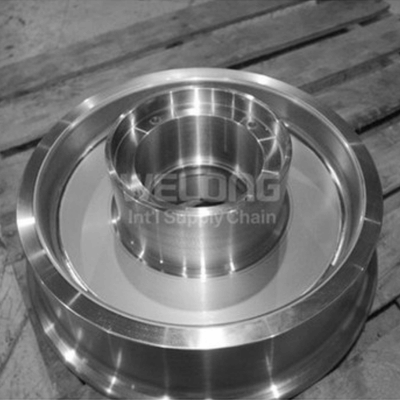

This article provides detailed information about crane drum units. If you are interested, please continue reading.
The crane drum assembly is one of the essential components of a crane. Its primary function is to wind the steel wire rope, serving as the power transmission channel between the prime mover and the steel wire rope, while also converting the rotational motion of the prime mover into linear motion. It is noteworthy that for cranes with a higher lifting height, it's advisable to use a new material for multi-layer winding to reduce the size of the drum. This material can have a surface with guiding helical grooves or a smooth texture. The drum winds the steel wire rope, bears the tension and pressure of the lifted load, and, in conjunction with other relevant crane mechanisms, facilitates the lifting and transportation of heavy objects.
The crane drum assembly system comprises the drum, connecting disc, and bearing bracket. The drum assembly can be categorized into two types: long-shaft drums and short-shaft drums. Long-shaft drum assemblies come in two variations: gear-connected disc assemblies and drum assemblies with large gears, with the latter being more commonly used. The short-shaft electric drum assembly represents a novel structural form where the drum is rigidly connected to the output shaft of the reducer using a flange plate. The reducer base is connected to the trolley frame via steel balls or cylindrical pins.
The drum finds extensive application across various lifting equipment, including single-beam cranes, double-beam cranes, gantry cranes, port machinery, ship winches, capstans, hoists, automated parking systems, and all-terrain cranes.
The following are common classifications of drums:
1,Based on shape: smooth drum, helical groove drum, single drum, double drum, broken wire drum.
2,According to the installation and matching of reducers: drum with toothed plate, drum with external gear, drum with coupling, drum with brake disc, European-style drum.
3,Based on the associated equipment: electric hoist drum, double-beam drum assembly, hoist drum, winch drum, automated parking system drum, etc.
4,Structurally, the drum assembly can be divided into drum-shaped groups with gear-connected discs and rolling groups with rigidly connected flanges. Drum-shaped groups with gear-connected discs: One end of the drum is connected to the gear-shaped output shaft of the reducer via a disc with internal teeth, and the drum assembly is equipped with spherical or drum-shaped roller connecting discs. Rolling groups with rigidly connected flanges: These rolling groups use flanges to rigidly connect to the cylindrical output shaft of the reducer, and the reducer base is connected to the crane frame via steel balls or cylindrical pins to eliminate adverse effects on load caused by deformation of rigidly combined parts of drum-shaped groups and racks. Apart from fixed shaft types, the other end of the drum uses short shafts.
5,Drum assemblies can be further categorized into single-layer winding drums and multi-layer winding drums based on the number of layers of steel wire rope winding. Single-layer winding drums are commonly used in bridge cranes. Cutting grooves on the surface of single-layer winding drums can increase the contact area between the steel wire rope and the drum, ensuring orderly arrangement of the steel wire rope and reducing friction between adjacent steel wire ropes, thereby enhancing the lifespan of the steel wire rope. The length dimension of the drum is subject to spatial limitations.
Similar to crane wheels being the most fragile part of the traveling mechanism, the drum is also a vulnerable part of the lifting mechanism, primarily due to long-term wear of the grooves. Additionally, when the drum wears out, the steel wire rope will quickly follow, posing a significant safety hazard. Moreover, replacing the drum is more complex than replacing crane wheels, requiring the disassembly of the entire lifting device, including the lifting motor, brake, steel wire rope, and hook (grab bucket or other hangers can be even more challenging). Therefore, high-quality steel wire rope drums are of paramount importance to you.
Speaking of drum manufacturing processes, welding and lathe machining are the most critical aspects. The welding process ensures the welding quality of the drum, guaranteeing its strength and rigidity. Generally, after welding, UT and MT testing are required to inspect the welding quality; lathe machining is carried out to ensure that the dimensions and tolerances of the drum meet the drawings and product requirements.
All we can do is utilize high-quality materials, adhere to appropriate processing techniques, and precisely manufacture the drum to ensure fine and standardized quality. The suitability of the drum depends on your working conditions. Of course, our engineers are ready to assist you when encountering such issues. In terms of exports, customized designs of drums are the most common due to varying specifications. Presently, this represents the production capacity we can offer.
If you are interested in rollers and other crane accessories, please visit our website or send an email to lydia@welongchina.com for detailed consultation. We look forward to hearing from you. If you have any other needs for customized metal parts, please feel free to contact us at any time.