
A friend from my daily study group in investment casting asked me to provide some photos of defective tree assemblies. To be honest, although encountering such issues is quite common during actual production, I haven't captured any pictures as evidence in a timely manner. So when this friend asked for them, I was caught unprepared. Since we've brought up this topic, I would like to take this opportunity to discuss it further. However, I must clarify that the following discussion is solely based on my personal insights, and everyone is welcome to engage in a discussion to validate or challenge these observations.
As we know, the tree assembly process actually consists of two or more steps - assembly and welding. The reason for mentioning two or more steps is that sometimes the wax patterns do not come with sprues and need to be fabricated or molded separately before being attached to the wax pattern and connected to the gating system. For example, in our company, most of the gates are not molded gates but require additional manual processes such as cutting and grinding. As a result, the dimensional consistency of manually fabricated gates is relatively poorer compared to molded gates.
Let's refocus on the defects in tree assemblies. These defects can occur during both assembly and welding processes. Assembly requires dimensional accuracy, so any inconsistencies or deviations from the specified dimensions in the process documentation can be considered as defects. Similarly, welding also demands proper quality, so any substandard welding can be regarded as a defect.
Some people might argue that tree assembly is a crucial step in the investment casting production and usually supported by process documentation, making it less likely to have defects. But is that really the case?
The answer is no. This step not only generates defects but also presents a wide variety of flaws. Let me provide a few examples to illustrate this point.
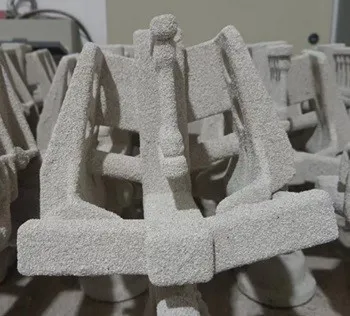
Firstly, let's discuss dimensional issues. This includes the dimensions of the sprues and the positional dimensions of the wax patterns. Generally, during tree assembly, rulers are used to accurately mark the positions of runners and internal sprues, followed by assembly according to the process drawings, ensuring vertical and horizontal alignment. Additionally, the dimensions of the gates and runners should be precisely maintained. Therefore, I generally discourage manual fabrication of gates and runners since it's challenging to achieve consistent dimensions, resulting in various shapes and appearances. The following image represents a typical example. With the same product and assembly scheme, we can clearly observe the diverse outcomes.

Here's a joke for you:
Why did the tree assembly at the casting foundry turn into a comedy act?
Because during pouring, they discovered that for the same product, one sprue cup was facing left while the other sprue cup was facing right. We were using a crucible-shaped cup for aluminum alloy vacuum gravity casting, which has a specific orientation. In the end, we found out that it was done by two different people. With the same process but different hands involved, we ended up with this hilarious left-right sprue joke.
Another issue is related to welding. Welding concerns two aspects: the weld joint itself and the strength of the weld. The weld joint aims to prevent the infiltration of face slurry that can lead to sand inclusion in the castings, while weld strength ensures the integrity of the shell operation. Both of these can be considered defects that may occur in tree assembly. A common weld joint defect is known as a cold solder. Unfortunately, without prior documentation, I cannot provide visual photos for you to see.
Perhaps some of you might find the latter defect more relatable while chuckling at the former one. What I want to emphasize is that investment casting involves multiple processes and numerous influencing factors. Any small aspect can have a significant impact on the quality of the casting. Therefore, it's crucial to strive for excellence in every detail. Only by doing so can we achieve the highest standards in the final casting quality.
Contact Us
For more information, please contact us at metal@welongpost.com.