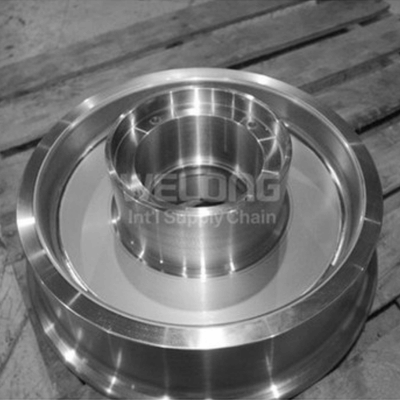

Hot rolling
Hot rolling is a metal processing process that occurs above the recrystallization temperature of the material. The grains recrystallize after being deformed during processing, which maintains an equiaxed microstructure and prevents cold work hardening of the metal. Starting materials are usually large pieces of metal, such as semi-finished castings, slabs, billets and billets. If the product comes from continuous casting, the product is usually fed directly to the rolling mill at the appropriate temperature. For smaller production scales, the raw materials start at room temperature and must be heated. Larger workpieces are heated in a soaking furnace fueled by oil, gas or natural gas, while smaller workpieces are heated in an electric induction furnace. When the raw material is heated in the furnace, its temperature must be monitored to ensure that the material temperature is above the recrystallization temperature of the metal material. In order to ensure a certain safety factor, the raw material heating temperature must be above the recrystallization temperature; this temperature value is generally 50°C to 100°C higher than the recrystallization temperature.
Hot-rolled metals generally have little directionality in their mechanical properties and residual stresses caused by deformation. However, in some cases, non-metallic inclusions can impart some directionality, and workpieces less than 20 mm thick usually have some directionality. In addition, non-uniform cooling can induce large residual stresses, which often occur in shapes with non-uniform cross-sections, such as I-beams. There is oxide scale on the surface of the rolled products, which is an oxide formed at high temperature. Scale is usually removed by pickling or surface cleaning surface processes. Dimensional tolerances on the final rolled product are typically 2 to 5% of the total dimensions.
It seems that hot-rolled mild steel has a wider range of carbon content than cold-rolled steel, making it more difficult for blacksmiths to control the quality of the finished product. Also for similar metals, the cost of hot-rolled products is generally lower than that of cold-rolled products.
Hot rolling is mainly used to produce sheet metal parts or products with simple profiles, such as rail tracks. Other typical uses for hot rolled metal include truck frames, automotive wheels, pipe and tubing, water heaters, farm equipment, belts, stampings, compressor casings, rolling stock components, wheel rims, architectural metal structures, railroad hopper cars, doors , shelves, CDs, guardrails, car clutch plates.
rolling design
Rolling mills are usually divided into roughing, intermediate processing and finishing. In the shape rolling process, the diameter of the initial blank (round or square), usually between 100-140 mm, is continuously rolled and deformed, resulting in a finished product with smaller cross-sectional size and geometry. Starting from a given blank, different sequences can be adopted to produce different final products. However, since each rolling mill is very expensive (up to 2 million euros), a typical requirement is a contract quantity or rolling pass. Some solutions have been obtained, including empirical knowledge, the use of digital model simulations and artificial intelligence technology. Lambiase et al used a finite element model (FE) to predict the final shape of a rolling strip passing through a round flat roll. One of the main issues in designing a rolling mill is to reduce the number of rolls; one possible solution to meet this requirement is to split the pass, reducing the profile reduction rate of each pass by increasing the number of rolls. Another solution for reducing the number of tool passes in a rolling mill is the use of an automated roll system proposed by Lambiase and Langella. Subsequently, Lambiase further developed an automation system based on artificial intelligence, specifically an integrated system, including an inference engine based on genetic algorithms, a knowledge database based on artificial neural networks, trained using a parametric finite element model, and the optimization and automation of the rolling mill. design.
cold rolled
Cold rolling is performed below the recrystallization temperature of the metal (usually at room temperature). Cold rolling can increase the strength of the material by up to 20% through strain hardening. It also improves surface finish and maintains tighter tolerances. Typically cold-rolled products include sheets, strips, bars, and rods; these products are typically smaller than their hot-rolled counterparts. Due to the small size of the workpiece and its greater strength, compared to hot rolling, it is necessary to use a cluster or higher than four-high roller mill. In cold rolling, the thickness of the blank is reduced less in single roller rolling than in hot rolling. Cold rolled sheet and strip are available in a variety of conditions: full hard, semi-hard, quarter-hard, and appearance rolled. Fully hard rolling reduces thickness by 50%, while other hardnesses reduce thickness by less. Annealing cold-rolled steel can increase ductility. Skin pass cold rolling can produce a minimum thickness reduction of: 0.5-1%. It is used to produce smooth surfaces, uniform thickness, and reduce yield point phenomena (preventing the formation of Luders bands during subsequent processing). It locks dislocations on the surface, thereby reducing the possibility of Lüders band formation. To avoid the formation of Lüders bands, the density of unpinned dislocations must be increased in the ferrite matrix. It is also used to break down brighteners in galvanized steel. Skin pass cold rolling is often used after cold rolling because the finished product needs to have good ductility. Other shapes can be cold rolled if the cross-section is relatively uniform and the transverse dimensions are relatively small. Cold rolled shapes require a series of shaping operations, usually along dimension lines, separation lines, roughing, semi-roughing and finishing. Smoother, more consistent steel with lower carbon content is easier to work with but also costs more in raw materials if handled by a blacksmith. Typical uses of cold rolled steel include metal furniture, office desks, filing cabinets, tables, chairs, motorcycle exhaust pipes, computer cabinets and hardware, household appliances and components, shelving, lighting fixtures, hinges, oil pipes, steel drums, Lawn mowers, electronic cabinets, water heaters, metal containers, fan blades, frying pans, wall and ceiling mounting kits, and various construction related products.