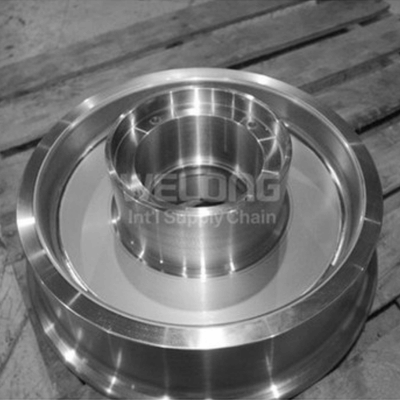

I Heat treatment cracks
Characteristics:
Morphology: heat treatment cracks are often produced in the martensitic transformation zone, so their cracks may crack along the crystal or crack through the crystal. Cracks may be radial, separate line or net.
Location: Cracks generally tend to form at sharp corners of the workpiece, at sudden changes in cross-section.
Section: The section of a quenching crack is usually not oxidised and may be white, dull white or light red (water rust caused by Quenching).
Causes:
Cracking occurs when the large stresses generated during Quenching are greater than the material's own strength and exceed the plastic deformation limit.
It may be related to factors such as too high a quenching heating temperature and too rapid cooling.
Reasons for heat treatment cracks
a. Material metallurgical quality:
Metallurgical problems such as shrinkage and severe rolling defects can cause material inhomogeneities that increase the risk of Quenching cracks.
Metallurgical defects such as macroscopic segregation, solid solution segregation, solid solution hydrogen, forging and rolling defects, slag entrapment, ferrite-pearlitic banding organisation and carbide banding organisation may act alone or in conjunction with macroscopic or microscopic internal stresses to cause Quenching cracks.
b. Material carbon content and alloying elements:
An increase in carbon content will reduce the fracture strength of martensite, thereby increasing the tendency of Quenching cracks.
Alloying elements such as Mn, Cr, V, Mo, etc. will also increase the tendency of quenching cracks with the increase of its content.
However, element B can effectively improve the hardenability, while the appropriate amount of rare earth elements can reduce the friction required for dislocation movement, reducing the tendency to brittle fracture.
c. Quenching process conditions:
Improper control of quenching heating method and heating rate, uneven heating, and too high quenching temperature may lead to Quenching cracks.
Quenching cooling method is not appropriate, the cooling rate is too fast, uneven cooling, as well as improper selection of cooling medium is also a common cause.
Quenching before the workpiece is not prepared for heat treatment or improper treatment, as well as tempering is not timely may also lead to quenching cracks.
d. Size and shape of the workpiece:
The sharp corners of the workpiece, cross-section mutations are prone to the formation of Quenching cracks, because these places are prone to stress concentration.
Large shaft parts are prone to thermal stress-induced cracks if they fail to be quenched when quenching.
e. Internal defects:
Defects existing within the material, such as vapour bubbles, inclusions, hairline, white spots, etc., may become a source of cracks under the action of heat treatment stress and gradually expand.
f. Martensite intrinsic brittleness:
The intrinsic brittleness of martensite is the internal cause of Quenching cracks, and its crystal structure, chemical composition, metallurgical defects, etc. will have an effect on it.
Quenching cracks are the result of a combination of factors, and need to be considered and optimised in a number of aspects, such as material selection, process control, workpiece design, etc., in order to reduce the risk of Quenching cracks.

Characteristics:
Morphology: forging cracks are formed at high temperatures, the cracks are relatively thick and generally exist in the form of multiple strips, without a fine tip, without a fine direction. Sometimes around the crack is not fully decarburised but semi-decarburised.
Position: often produced in the coarse organisation, stress concentration or alloying elements at the segregation.
Section: the crack section may be dark brown, or even have the appearance of oxygen skin, this is because the crack in the forging deformation to expand and contact with the air.
Causes:
Raw material defects:
Residual shrinkage: Incompletely closed pores or holes in the raw material may lead to a reduction in the strength of the material during the forging process, which makes it easy to produce cracks.
Inclusions in steel:
non-metallic inclusions, carbide segregation, heterogeneous metal inclusions in the raw material may weaken the continuity of the material and promote the formation of cracks.
Improper forging process:
improper heating:
the heating temperature is too high or too low, which may lead to uneven distribution of stress within the material, which in turn produces cracks during forging.
improper deformation:
the deformation rate is too large, the plasticity of the steel is not enough to withstand the shape of the pressure, easy to cause rupture. This crack often occurs at the beginning of the forging stage, and rapid expansion.
improper cooling after forging:
the cooling rate is too fast or too slow, may lead to internal stress concentration in the material, triggering cracks.
not timely heat treatment:
after forging is not timely and appropriate heat treatment, may lead to the material internal stress is not effectively released, thus increasing the risk of cracking.
g. improper temperature control:
In the heating and cooling process, if the temperature is not properly controlled, it may lead to excessive internal stress in the material, thus triggering cracking. For example, in the Quenching process, if the cooling is too fast, quenching cracks may occur.
h. Material stress concentration:
If there are stress concentration areas in the forging, such as sharp corners and cross-section mutations, when the stress exceeds the material's capacity, it may lead to cracking.