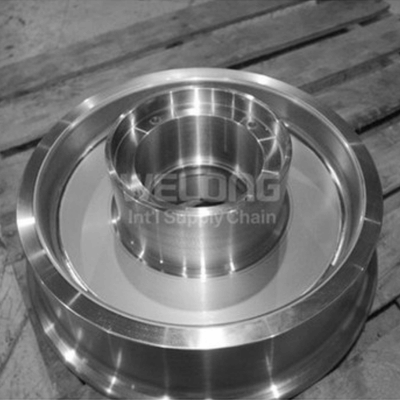

III. Cracks in raw materials
Characteristics:
Raw material cracks are formed primarily during the manufacturing or handling of materials and may vary in character and form depending on the specific material and manufacturing process.
These cracks may exist within or on the surface of the material and may expand further during subsequent processing or use.
Causes of generation:
a. Internal Stress
Thermal stresses: Stresses in the material due to temperature changes during processing or manufacturing. If these stresses exceed the strength or toughness of the material, they can lead to the appearance of microcracks.
Deformation stress: Stresses generated during deformation of the material by pressing, stretching, etc. If the deformation is too large, it may lead to microcracks within the material.
b. Excessive impurity elements
Sulphur, phosphorus and other elements: Excessive levels of these elements may lead to localised segregation of the metal, making the strength of the material less than the rest of the parent material, thus increasing the risk of microcracking. For example, excessive sulfur and phosphorus and other impurity elements may lead to localised segregation of the metal, causing cracks.
c. Mixture
Non-metallic inclusions: such as sand holes, air holes, etc. These inclusions will weaken the continuity of the material and become the starting point of cracks.
d. Carbide aggregation carbide aggregation:
In Quenching is prone to overcooking phenomenon, so that the material is prone to cracking, the formation of micro-cracks.
e. Problems with raw material manufacturing process
Excessive pressing deformation: Excessive pressing deformation may cause damage to the steel, resulting in microcracks.
Excessive cutting burrs: Excessive burrs generated during the cutting process may also cause damage to the steel, leading to microcracks.
Distinguishing methods of metal cracks
1. Observation by the naked eye
Principle: Judge by observing the cracks on the metal surface by human eyes under the light condition.
Characteristics: Simple and easy, applicable to simple appearance inspection of metal parts. However, the disadvantage is that the size and depth of cracks cannot be judged accurately.
2. Magnetic particle detection method
Principle: use self-magnetic field sensor to detect cracks on the surface of metal parts. After applying magnetic powder, the magnetic powder will be adsorbed near the crack to produce magnetic powder lines, thus revealing the crack information.
Characteristics: High precision, able to detect small cracks. But the operation requirements are strict, such as magnetic field strength, direction, etc. need to be within a certain range.
3. Coating method
Principle: By applying a specific liquid, the difference in surface tension of the liquid is used to detect cracks. The liquid will gather at the crack to form a specific pattern.
Characteristics: simple and easy, but the viscosity and surface tension of the liquid requires high, and can only detect surface cracks.
4. Penetration Detection Method
Principle: Detect shallow surface cracks by applying chemicals to form an absorbent dye on the metal surface. After the penetrant enters the crack, the crack is judged by observing the dye residue through steps such as painting and cleaning.
Characteristics: It can detect small surface cracks and reflect the crack depth information. However, the detection results are greatly affected by the technical ability of the operator, and the penetrating solution is costly and harmful to human body.
5. Ultrasonic detection method
Principle: by releasing high-frequency sound waves to the surface of metal parts to detect cracks within the metal. The use of sound waves in different materials between the reflection and refraction, measurement of reflection and refraction time and energy differences to detect cracks.
Characteristics: High precision, can detect the internal crack information of metal parts. However, it requires special equipment and high operation requirements.
6. Ray detection technology
Principle: use the detection of ray in the defects and non-destructive parts of the penetration rate is different to determine the presence or absence of defects.
Characteristics: the detection results image intuitive, for the mutation of defects detection rate is high, but the gradual change of defects such as crack detection effect is poor, and serious pollution of the environment.
Heat treatment cracks: mainly related to the quenching process, the crack characteristics are obvious, mostly appearing in the stress concentration area of the workpiece.
Forging cracks: closely related to the forging process, the crack form is bold, mostly caused by internal defects in the material or improper forging process.
Raw material cracks: originated from the material manufacturing process, may exist in the material or on the surface, its characteristics and morphology due to the material and manufacturing process varies.
Through careful observation of the crack form, location and cross-section characteristics, and combined with the possible causes of cracks, we can more accurately distinguish between metal heat treatment cracks, forging cracks and raw material cracks.
If you have any questions about metal cracks, welcome to discuss!