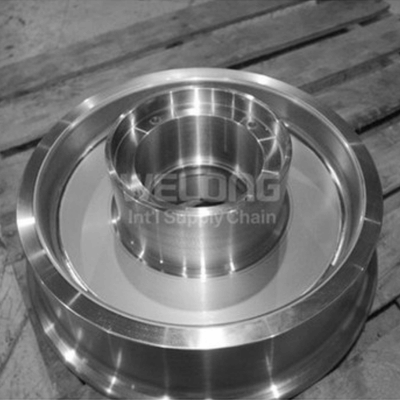

For machine parts with higher requirements for strength, plasticity and toughness, steel castings are required. The output of steel castings is second only to cast iron, accounting for about 15% of the total output of castings.
1. Classification of chemical composition
According to the chemical composition, cast steel can be divided into two categories: carbon cast steel and alloy cast steel. Among them, carbon cast steel is the most widely used, accounting for more than 80% of the total output of cast steel.
1. Carbon cast steel
Generally, low carbon steel ZG15 has a high melting point and poor casting performance, and is only used to manufacture motor parts or carburized parts; medium carbon steel ZG25~ZG45 has a comprehensive performance higher than all kinds of cast iron, that is, high strength, excellent plasticity and toughness, so it is suitable for manufacturing parts with complex shapes and high strength and toughness requirements, such as train wheels, forging hammer frames and anvils, rollers and high-pressure valves, etc., which is the most widely used type of carbon cast steel; high carbon steel ZG55 has a low melting point and better casting performance than medium carbon steel, but its plasticity and toughness are poor, and it is only used to manufacture a few wear-resistant parts.
2. Alloy cast steel
According to the total amount of alloy elements, alloy cast steel can be divided into two major categories: low alloy steel and high alloy steel.
① Low alloy cast steel, my country mainly uses manganese, manganese silicon and chromium series. Such as ZG40Mn, ZG30MnSi1, ZG30Cr1MnSi1, etc. It is used to manufacture parts such as gears, hydraulic press working cylinders and turbine rotors, while ZG40Cr1 is often used to manufacture important force-bearing parts such as high-strength gears and high-strength shafts.
② High-alloy cast steel has special properties such as wear resistance, heat resistance or corrosion resistance. For example, high-manganese steel ZGMn13 is a wear-resistant steel, which is mainly used to manufacture parts used under dry friction working conditions, such as the front wall and grab teeth of excavators, tracks of tractors and tanks, etc.; chromium-nickel stainless steel ZG1Cr18Ni9 and chromium stainless steel ZG1Cr13 and ZGCr28, etc., have high corrosion resistance to nitric acid and are mainly used to manufacture parts for chemical, petroleum, chemical fiber and food equipment. 2. Casting process characteristics of cast steel
The mechanical properties of cast steel are higher than those of cast iron, but its casting performance is worse than that of cast iron. Because cast steel has a high melting point, molten steel is easily oxidized, the fluidity of molten steel is poor, and the shrinkage is large. Its volume shrinkage is 10-14%, and its linear shrinkage is 1.8-2.5%. In order to prevent defects such as insufficient pouring, cold shut, shrinkage and shrinkage, cracks and sand sticking in steel castings, more complex process measures than cast iron must be taken:
1. Due to the poor fluidity of molten steel, in order to prevent cold shut and insufficient pouring of steel castings, the wall thickness of steel castings cannot be less than 8mm; the structure of the pouring system should be simple and the cross-sectional size should be larger than that of cast iron; dry casting or hot casting should be used; the pouring temperature should be appropriately increased, generally 1520°~1600℃, because the pouring temperature is high, the superheat of molten steel is large, and the liquid state is maintained for a long time, and the fluidity can be improved. However, if the pouring temperature is too high, it will cause defects such as coarse grains, thermal cracking, pores and sand sticking. Therefore, the pouring temperature of small, thin-walled and complex-shaped castings is about the melting point of steel + 150℃; the pouring temperature of large, thick-walled castings is about 100℃ higher than its melting point.
2. Since the shrinkage of cast steel is much greater than that of cast iron, in order to prevent shrinkage and shrinkage defects in castings, risers, chillers and subsidies are mostly used in the casting process to achieve sequential solidification.
In addition, in order to prevent shrinkage, shrinkage, pores and cracks in steel castings, the wall thickness should be uniform, sharp corners and right-angle structures should be avoided, sawdust should be added to the sand used for castings, coke should be added to the core, and hollow cores and oil sand cores should be used to improve the yield and air permeability of the sand mold or core.
The melting point of cast steel is high, and its pouring temperature is also high accordingly. At high temperatures, the interaction between molten steel and casting materials is very likely to produce sand sticking defects. Therefore, artificial quartz sand with high refractoriness should be used as the casting mold, and a coating made of quartz powder or zircon sand powder should be brushed on the surface of the casting mold. In order to reduce the source of gas, improve the fluidity of molten steel and the strength of the casting mold, most steel castings are cast with dry molds or quick-dry molds, such as CO2-hardened water glass sand molds. 3. Heat treatment of steel castings
Steel castings should be used after heat treatment. Because there are casting defects such as pores, cracks, shrinkage cavities and shrinkage, coarse grains, uneven structure and residual internal stress inside the cast steel parts, the strength, especially the plasticity and toughness of the cast steel parts are greatly reduced.
In order to refine the grains, make the structure uniform and eliminate internal stress, the steel castings must be normalized or annealed. The mechanical properties of steel after normalizing are higher than those after annealing, and the cost is also lower, so it is widely used. However, since normalizing will cause greater internal stress than annealing, it is only suitable for steel castings with a carbon content of less than 0.35%. Because low-carbon steel castings have good plasticity and are not easy to crack when cooling. In order to reduce internal stress, steel castings should also be tempered at high temperature after normalizing. For steel castings with a carbon content of ≥0.35%, complex structure and prone to cracking, only annealing can be performed. Steel castings should not be quenched, otherwise they are very easy to crack. 4. Melting of cast steel
Cast steel is generally melted in open-hearth furnaces, electric arc furnaces and induction furnaces. The characteristics of open-hearth furnaces are large capacity, the use of scrap steel as raw materials, the ability to accurately control the composition of steel and the ability to melt high-quality steel and low-alloy steel. They are mostly used to melt molten steel for large steel castings with high quality requirements.
The three-phase electric arc furnace is easy to open and shut down, can ensure the composition and quality of molten steel, has no strict requirements on furnace materials, and is easy to heat up. Therefore, it can smelt high-quality steel, high-grade alloy steel and special steel, etc. It is a common equipment for producing molded steel castings.
In addition, the use of industrial frequency or medium frequency induction furnaces can melt various high-grade alloy steels and steels with extremely low carbon content. The induction furnace has a fast melting speed, small alloy element burnout, low energy consumption, and high quality of molten steel, that is, low impurity content and few inclusions, which is suitable for small steel casting workshops.
Contact Us
For more information, please contact us at metal@welongpost.com.